| Workshop | Purpose | Focus | Timing |
| 1 | Knowledge, showcasing and contextualisation | Build foundational understanding of the RHINO approach and IBAT and how the two can support implementation of IBSAP, TNFD and other existing biodiversity frameworks. | October/November 2026 – TBD |
| 2 | Technical application and practical training | Practical skills and technical understanding which enables organisations to start exploring RHINO application using IBAT. | 2027 |
| 3 | Action, sharing case studies and future implementation | Consolidate knowledge and the network, share case studies, identify landscapes for co-ordinated multi-stakeholder action, integrate new developments in the approach and operationalise it in an Indonesian context | 2028 |
The workshops are expected to bring together approximately 30 participants from the private sector, government, civil society and scientific communities. The majority of participants will be business representatives.
The first workshop, provisionally planned for October/November 2026, will:
The second workshop for 2027, subject to development:
The third workshop for 2028, subject to development will:
Project team roles
IUCN is leading on technical development of the workshops. IBCSD is managing event logistics and will host and co-facilitate the workshops with the consultant.
To support this process, IUCN is seeking a consultant:
Workplan agreed with IBCSD
September will be dedicated to formulating the potential pre-workshop ‘launch’ event and workshop
Overview of activities agreed with IBCSD:
| Activities | Lead |
| 1. Organise potential short ‘launch’ event
Draft agenda and develop content for the launch event
Participant identification and engagement
Secure event logistics set-up: venue, translation, AV etc.
Hosting & Facilitation
Content delivery
*Consultant expected to attend for on-boarding purposes and to use insights to inform workshop 1.
|
IUCN
IBCSD and IUCN ARO
IBCSD
IBCSD
IUCN
|
| 2. Stakeholder identification & engagement for workshop 1
Propose relevant stakeholders from within and beyond the IBCSD network for the workshop. Engage with relevant national, state and local authorities (e.g. municipalities) to secure involvement of priority bodies
|
IBCSD |
| 3. Workshop 1 – content development
Draft agenda and develop content for the workshop.
Consultant develops synthesis of Indonesia’s regulatory environment and its alignment with the IUCN RHINO approach to be integrated into the workshop.
Consultant designs the facilitation model and plans the workshop design and run-of-show in consultation with project team.
|
IUCN
Consultant
Consultant |
| 4. Workshop 1 – Logistics set up
Secure venue, AV set-up and all event logistics
Finalise workshop content package |
IBCSD
IUCN with consultant and IBCSD |
| 5. Workshop 1 – Stakeholder outreach
Manage stakeholder invitations, outreach, and engagement |
IBCSD |
| 6. Workshop 1 – delivery
Event logistics and facilitation of workshop
Content delivery |
IBCSD & consultant
IUCN & consultant |
| 7. Workshop 1 – Post workshop follow-up
Feedback surveys, lessons learned, communication between workshops and reporting back to KNCF |
IUCN/ IBCSD |
A similar workplan will be used for years 2 and 3.
Consultant’s Mission – Scope of work and associated activities
To ensure success of the workshops IUCN wants to mobilise the expertise of a consultant
The consultant will report to the designated IUCN Project Manager and participate in regular coordination meetings with IUCN and IBCSD related to the workshop. The IUCN Project Manager will ensure proper briefing on progress to the consultants and provide any relevant information.
The consultant assignment will focus on:
The assignment focus for year 2 and 3 will be determined following year 1. An initial indication of year 2 and 3 activities and deliverables is provided below.
Activities
The consultant will be expected to undertake the following activities:
For all three years
The consultant will:
For Year 1
If the short ‘launch’ event goes ahead in October, use the participant engagement demonstrated at that event (who attends, what questions they ask, how motivated and interested they are in the content, which parts of the content do they seem most interested in), to inform the design of workshop 1 content, facilitation model and delivery style.
Review and synthesise relevant national and, where appropriate, sub-national policies, strategies, regulations and institutional frameworks that are relevant to biodiversity conservation, species protection, land and natural resource management, corporate sustainability and Nature Positive action.
The review should identify the key entry points through which the RHINO approach could support or complement existing Indonesian biodiversity policies, strategies and implementation mechanisms.
Assess the relevance and potential application of RHINO across key sectors with significant biodiversity impacts and corporate contexts in Indonesia.
The assessment should identify opportunities for RHINO to complement existing corporate practices and help businesses move from biodiversity assessment and disclosure towards practical, measurable actions that contribute to biodiversity outcomes.
Based on the policy, regulatory and corporate landscape review, assess how the IUCN RHINO approach can best be aligned, integrated and adapted to the Indonesian context.
Year 2
Year 2 and 3 activities will be determined subject to workshop 1 and developments in the IUCN RHINO approach over time. An indicative list of activities is provided below. Alongside this the consultant will lead on facilitation design and delivery for workshop 2 and 3, as done for workshop 1.
Undertake a gap analysis and assess how IUCN RHINO can be implemented in Indonesia:
Year 3
Based on the analysis, develop learning materials that introduce the RHINO approach in a manner that is relevant and accessible to Indonesian stakeholders.
Consultant’s mission – Deliverables, timeline and budget
The consultant will be expected to deliver the following outputs:
For all three years
Deliverable 1: Workshop facilitation design and facilitation delivery
Year 1
Deliverable 2: Inception approach and workplan
A short inception note setting out:
Deliverable 3: Draft Indonesia RHINO contextualisation and alignment overview
A concise, synthetic overview of Indonesia’s relevant regulatory, corporate and sectoral landscape.
The overview should clearly set out how the IUCN RHINO approach could be aligned, integrated and adapted within the Indonesian context, including its potential contribution to international, national and corporate biodiversity goals.
The output should be presented in a PowerPoint presentation or equivalent format, suitable for use as a background and discussion document for Workshop 1 and as a reference for subsequent workshops.
The consultant will coordinate with IUCN to ensure that the materials are technically consistent with the RHINO approach and suitable for delivery by IUCN and project partners. The consultant will revise and finalise the contextualisation overview based on feedback from IUCN and relevant project partners.
Year 2
Year 2 and 3 deliverables will be determined subject to workshop 1 and developments in the IUCN RHINO approach over time. An indicative list of deliverables is provided below. Alongside this the consultant will lead on facilitation design and delivery for workshop 2 and 3.
Deliverable 4: RHINO in Indonesia Implementation Planning and Readiness Assessment
Year 3
Deliverable 5: RHINO learning materials
Develop a set of learning, guidance and presentation materials for Indonesian (and potentially Japanese) stakeholders to implement the IUCN RHINO approach.
The final materials will serve as a basis for future RHINO pilot activities and stakeholder engagement in Indonesia.
Indicative timeline
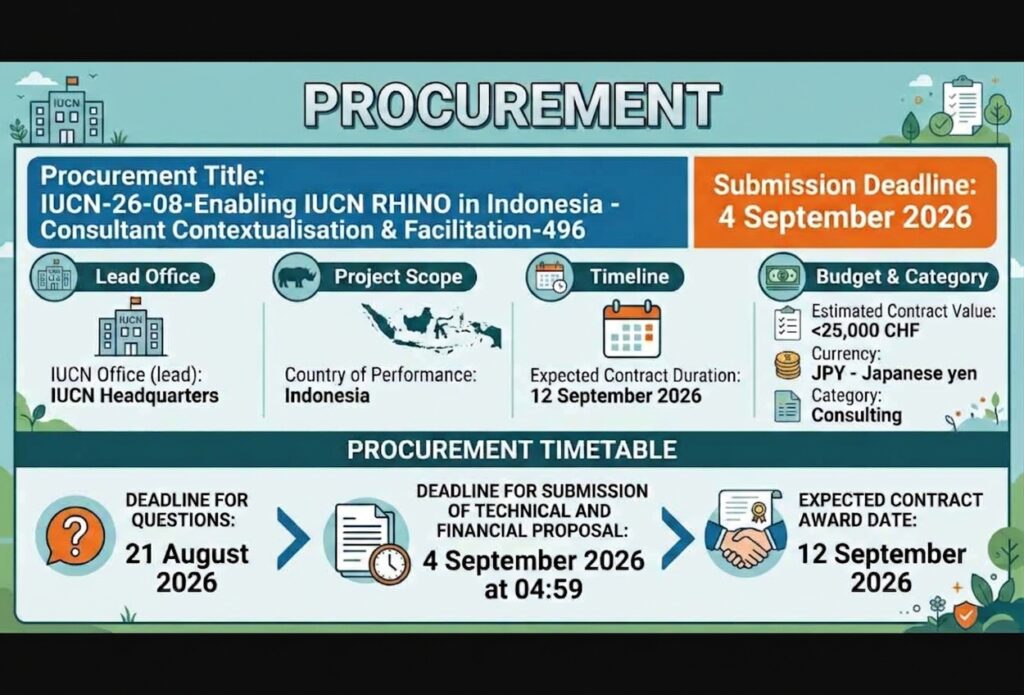
Workshop 1 assignments are predominately expected to be undertaken in September-November 2026, with final materials completed ahead of the first RHINO workshop.
The indicative timeline is:
| Activity | Timing |
| Contracting and inception meeting | August / Early September |
| Inception approach and workplan | Early September |
| Analysis | September |
| Draft contextualisation and alignment overview | Mid September |
| IUCN and partner review | Late September |
| Final contextualisation overview | At least three weeks in advance of workshop 1 |
| Workshop design | October |
| Workshop 1 | October/November 2026. |
The consultant may be expected to participate in selected coordination meetings with IUCN and project partners, and the consultant will be required to attend the short ‘launch’ event in October, if the event takes place.
The timeline for assignments for Year 2 and 3 are to be confirmed following completion of Year 1 assignments.
Budget
The maximum budget is 1560000 Japanese Yen per a year
Requirements
A multidisciplinary team may be proposed where the required expertise cannot be provided by a single consultant. The team lead must meet all requirements listed or provide a good explanation of how as a team all requirements are met.

The Jurisdictional Approach (JA), supported by the Sustainable Jurisdictional Indicators (SJI) framework, offers a promising pathway to address these challenges. By enabling coordinated action across government agencies, private sector actors, and local communities, the approach supports landscape-level verification systems, strengthens traceability infrastructure, improves land governance, and enhances market readiness. Furthermore, jurisdictional performance can help unlock access to forest-positive financing mechanisms, including blended finance, green bonds, and carbon finance, creating opportunities for long-term sustainable development.
As interest in jurisdictional approaches continues to grow among policymakers, investors, development partners, and commodity market actors, there is a need to document emerging experiences, lessons learned, opportunities, and implementation pathways. To support knowledge sharing and broader uptake of the approach, The Tropical Forest Alliance seeks to develop a knowledge publication that communicates the strategic value of the Jurisdictional Approach in strengthening market compliance, improving smallholder inclusion, and mobilizing sustainable finance.
The knowledge publication aims to:
The selected consultant or consulting firm will be responsible for developing a high-quality knowledge publication that documents the strategic value, implementation pathways, challenges, and opportunities of the Jurisdictional Approach (JA) and Sustainable Jurisdictional Indicators (SJI) framework in supporting market compliance and sustainable finance. The scope of work includes, but is not limited to, the following activities:
The consultant is expected to deliver the following outputs:
Please submit your CV and a one-page summary of relevant experience for the position to Nadila Simbolon at [email protected] no later than Friday, 3 July.

Emerging financing approaches such as guarantee facilities, blended finance, offtake-backed financing, and technical assistance facilities offer opportunities to mobilize capital, reduce risks, and support forest-positive enterprises. At the same time, Indonesia’s sustainable finance agenda, including the Indonesia Taxonomy for Sustainable Finance (TKBI), climate finance initiatives, and green finance targets, creates opportunities to scale financing solutions that contribute to sustainable and deforestation-free supply chains.
To support stakeholder engagement and inform future initiatives, The Tropical Forest Alliance seeks a qualified consultant or consulting firm to develop a publication on Forest-Positive Financing for MSMEs in Indonesia.
The objective of this assignment is to develop an evidence-based publication that examines opportunities, challenges, and innovative financing mechanisms for MSMEs operating in forest-positive and sustainable commodity value chains in Indonesia. The publication is expected to provide actionable insights and recommendations for financial institutions, investors, donors, philanthropic organizations, policymakers, private sector actors, and MSME ecosystem stakeholders.
The selected consultant shall undertake the following activities:
Conduct a review of relevant literature, policies, financing mechanisms, market initiatives, and existing studies related to:
Conduct consultations and interviews with relevant stakeholders, including:
Analyze findings and develop a publication that assesses financing opportunities and proposes recommendations for scaling forest-positive financing for MSMEs in Indonesia.
The publication should cover the following themes:
Deliverable 1: Inception & Publication Planning
An inception report outlining the methodology, workplan, stakeholder engagement approach, and proposed publication outline.
Deliverable 2: Stakeholder Consultation Summary
A summary of stakeholder consultations, including key findings, opportunities, challenges, and emerging themes relevant to forest-positive financing for MSMEs.
Deliverable 3: Draft Publication
A draft publication for review and feedback.
Deliverable 4: Final Publication Package
A final publication package consisting of:
The consultant or consulting firm should demonstrate:
Please submit your CV and a one-page summary of relevant experience for the position to Nadila Simbolon at [email protected] no later than Friday, 26 June.
The primary purpose of this consultancy is to support the development of a comprehensive, technically sound, and align with government requirement standard (SKKNI) for Resource Efficient and Clean Production (RECP) In Indonesia, in order to strengthen green skills development, promote green jobs and accelerate the greening of the industrial sector.
The specific objectives are:
The Consultant will provide technical expertise and project management throughout the full cycle of SKKNI development, from inception to final submission. The scope of work encompasses the following seven key activities:
The Consultant will lead a qualified team of RECP and SKKNI experts to develop the first draft of the SKKNI RECP through benchmarking national and international competency standards, integrating existing RECP training materials, and structuring the document in accordance with Kemnaker requirements for internal review and stakeholder consultation.
The consultant will conduct mapping to identify relevant job roles and competency units within the RECP ecosystem.
The Consultant will conduct structured consultations with relevant government ministries, including Kemnaker and KLH, to ensure the SKKNI RECP aligns with applicable regulations, environmental standards, and green industry priorities, while documenting all engagement outcomes for reporting to IBCSD
The Consultant will organize and facilitate the first FGD with relevant stakeholders from government, industry, training institutions, civil society, and academia to review the zero draft of the SKKNI RECP, gather technical inputs, and collect additional data to strengthen and finalize the document. Following FGD 1, the Consultant will update and refine the draft SKKNI to produce a Second Draft, incorporating all inputs and data collected during the discussion.
The Consultant will organize and facilitate a second FGD to review the updated Second Draft of the SKKNI RECP, address remaining technical issues, strengthen stakeholder consensus, and incorporate final inputs into the Third Draft of the document.
The Consultant will finalize the draft SKKNI RECP by consolidating inputs from both FGDs and stakeholder engagements, ensuring compliance with Kemnaker requirements, and submitting the completed document to IBCSD for review and approval prior to the Validation Workshop
The Consultant will support IBCSD in organizing and facilitating a formal Validation Workshop, in coordination with relevant ministries, to validate the finalized SKKNI RECP draft, confirm stakeholder consensus on competency units, and document all outcomes in a comprehensive workshop report.
Following the Validation Workshop, the Consultant will finalize the SKKNI RECP document by incorporating all validation feedback, preparing the complete submission package in line with Kemnaker requirements, and supporting IBCSD in the formal submission process for adoption consideration
The expected outcomes from this consultancy include:
It is expected that the consultant will be able to deliver all outputs within 5 (five) months from the signing of contract. The consultant is expected to submit their own detailed timeline and work plan that still in accordance with proposed detailed scheduled below:
| No | Tasks | Deliverables/Products | Expected Schedule |
| 1 | Kick-off Meeting & Inception Report | Inception Report including work plan, detailed methodology, and team structure | Week 1 |
| 2 | Development of SKKNI Draft by Expert Team | First Draft of SKKNI RECP document (zero draft) | Week 2 – 5 |
| 3 | Engagement with Relevant Ministries | Minutes of Meetings with Kemnaker and KLHK; Kementerian Perindustrian, BNSP, LSP; Engagement Summary Report | Week 3 – 6 |
| 4 | Focus Group Discussion (FGD) 1 | Minutes of FGD 1; Updated SKKNI Draft (Second Draft) | Week 7 – 8 |
| 5 | Focus Group Discussion (FGD) 2 | Minutes of FGD 2; Revised SKKNI Draft (Third Draft) | Week 9 – 10 |
| 6 | Finalization of SKKNI Draft | Finalized SKKNI Draft ready for validation | Week 10 – 13 |
| 7 | Validation Workshop | Validation Workshop Activity Report; Post-validation SKKNI Draft | Week 14 – 15 |
| 8 | Final Revision & Submission | Final SKKNI Document (Bahasa Indonesia); Executive Summary; Submission Report to Kemnaker | Week 16 – 20 |
lagi, The Consultant’s fee will be disbursed in three (3) payment installments (termin) tied to key milestones as follows:
| Termin | Payment Schedule | Milestone/Trigger | % of Total Fee |
| 1 | Upon signing of contract and submission of Inception Report | Signed Contract, Inception Report approved by IBCSD, and submission of Invoice. | 30% |
| 2 | Upon completion of FGD 2 and submission of Third Draft SKKNI | FGD 2 Minutes of Meeting, Third Draft SKKNI accepted by IBCSD (including receipt of comments and/or revision requests, if any), and submission of Invoice. | 40% |
| 3 | Upon submission and acceptance of Final SKKNI Document | Final SKKNI Document approved by IBCSD, Executive Summary and Validation Workshop Report accepted and Approved by IBCSD, and submission of Invoice. | 30% |
All payments are subject to the submission and acceptance of the relevant deliverables by IBCSD. Invoices shall be submitted to IBCSD upon achievement of each milestone.
The following documents are to be submitted by the Consultant as part of the proposal submission:
The Consultant is expected to submit their legal documents (e.g., Decree of Establishment / SK Menkumham atas Pengesahan Akta, Taxpayer Identification / NPWP), a corporate profile with a good record of performance and integrity, proven experience in technical standard development and/or workforce competency frameworks, and the Curriculum Vitae of the lead consultant and key team members.
The Consultant is expected to submit a technical proposal which outlines their understanding of this Term of Reference, their proposed approach and methodology for SKKNI development, and their team’s relevant experience. The technical proposal should contain:
The Consultant is expected to submit a commercial proposal covering all personnel and non-personnel costs in the most competitive offer possible. The commercial proposal should be submitted in Excel (.xls or .xlsx) format with a breakdown of costs sufficient to assess reasonableness and compliance with funder requirements. A competitive payment schedule associating invoice amounts with the milestones outlined in Section G should also be included.
The above documents shall be submitted at the latest of:
Day/Date : Friday, June 17 th, 2026
Time : 17.00 WIB
For any clarifications needed by the Consultant, kindly contact the following: [email protected]
The consultant will be responsible for the following tasks:
Collect, organize, and maintain program reports, activity documentation, data, and supporting evidence from different program teams.
Consolidate program updates, achievements, lessons learned, challenges, and key insights into a structured knowledge repository.
Analyze program reports and implementation evidence to identify emerging patterns, strategic insights, and institutional learning.
Support the development of knowledge products based on program results, such as briefs, case studies, learning notes, program summaries, impact stories, and presentation materials.
Translate program evidence and lessons learned into practical knowledge that can support IBCSD’s program development, strategic communication, donor engagement, stakeholder outreach, and institutional positioning.
Ensure that relevant knowledge generated from IBCSD’s programs is properly documented, accessible, and reusable for future program design, reporting, and organizational learning.
The consultant is expected to produce:
Education
Experience
Technical Competencies
Personal Competencies
The consultant assignment will be for a period of 3 (three) to 6 (six) months, starting from the effective date of the contract, with the possibility of extension based on program needs and the consultant’s performance evaluation.
The consultant is expected to commence the assignment as soon as possible, with a target start date of 15 June 2026, or as mutually agreed by both parties.
The level of effort for this assignment is estimated at approximately 5 (five) to 10 (ten) working days per month, depending on program needs and deliverables.
Applicants are requested to submit:
Application submission deadline: June 11, 2026
Applications should be submitted to:[email protected]

In response to these developments, the Government of Indonesia has strengthened the Indonesian Sustainable Palm Oil (ISPO) certification framework through a series of regulatory reforms aimed at improving sustainability compliance, governance, traceability, and institutional coordination. Despite these efforts, significant challenges remain regarding implementation effectiveness, institutional capacity, smallholder inclusion, transparency, market credibility, and international acceptance. There is therefore a growing need for a comprehensive and evidence-based policy paper that critically assesses the current state of ISPO and identifies strategic pathways for strengthening its governance, implementation, and international positioning.
The objective of this assignment is to develop a policy paper that analyses the current state, challenges, and future direction of ISPO across six interrelated dimensions:
The study is expected to generate practical, evidence-based, and actionable policy recommendations to strengthen ISPO implementation, institutional effectiveness, market credibility, and smallholder inclusion within Indonesia’s sustainable palm oil governance framework.
The selected consultant/research team will be expected to:
The selected consultant/team is expected to deliver the following outputs:
The assignment requires a consultant, research institution, or expert team with:
Please submit your CV and a one-page summary of relevant experience for the position to Nadila Simbolon at [email protected] no later than Friday, 12 June.