REQUEST FOR PROPOSAL (RFP) Development of Knowledge Publication on Jurisdictional Approach for Market Compliance and Sustainable Finance

The Jurisdictional Approach (JA), supported by the Sustainable Jurisdictional Indicators (SJI) framework, offers a promising pathway to address these challenges. By enabling coordinated action across government agencies, private sector actors, and local communities, the approach supports landscape-level verification systems, strengthens traceability infrastructure, improves land governance, and enhances market readiness. Furthermore, jurisdictional performance can help unlock access to forest-positive financing mechanisms, including blended finance, green bonds, and carbon finance, creating opportunities for long-term sustainable development.

As interest in jurisdictional approaches continues to grow among policymakers, investors, development partners, and commodity market actors, there is a need to document emerging experiences, lessons learned, opportunities, and implementation pathways. To support knowledge sharing and broader uptake of the approach, The Tropical Forest Alliance seeks to develop a knowledge publication that communicates the strategic value of the Jurisdictional Approach in strengthening market compliance, improving smallholder inclusion, and mobilizing sustainable finance.

  1. Objective

The knowledge publication aims to:

  1. Document and communicate the role of the Jurisdictional Approach in responding to emerging global market compliance requirements, particularly EUDR and related due diligence regulations.
  2. Highlight key challenges associated with traceability, land legality, and smallholder inclusion within commodity supply chains.
  3. Showcase how the Sustainable Jurisdictional Indicators (SJI) framework can support landscape-level governance, compliance readiness, and risk reduction.
  4. Present opportunities for leveraging jurisdictional performance to attract sustainable and forest-positive finance, including blended finance, green bonds, and jurisdictional carbon mechanisms.
  5. Generate practical insights and recommendations for governments, private sector actors, financial institutions, and development partners seeking to strengthen sustainable commodity production and market access.
  6. Produce an accessible and evidence-based knowledge product that can support advocacy, policy dialogue, investment engagement, and replication of jurisdictional approaches in other regions.

3. Scope of Work

The selected consultant or consulting firm will be responsible for developing a high-quality knowledge publication that documents the strategic value, implementation pathways, challenges, and opportunities of the Jurisdictional Approach (JA) and Sustainable Jurisdictional Indicators (SJI) framework in supporting market compliance and sustainable finance. The scope of work includes, but is not limited to, the following activities:

Task 1. Inception and Publication Planning

  • Review relevant documents and references.
  • Develop the publication framework, key messages, and outline.

Task 2. Research and Stakeholder Consultation

  • Conduct desk research and stakeholder consultations.
  • Gather evidence, case studies, and key insights for the publication.

Task 3. Content Development

  • Develop and draft the publication manuscript in English.
  • Incorporate feedback from the project team and stakeholders.

Task 4. Editing and Finalization

  • Revise, edit, and proofread the publication.
  • Ensure the publication is ready for design and dissemination.

Task 5. Submission

  • Submit the final publication manuscript and all editable source files.

Expected Deliverables

The consultant is expected to deliver the following outputs:

  1. Publication outline and content framework.
  2. Stakeholder consultation summary.
  3. First draft of the knowledge publication.
  4. Revised draft incorporating stakeholder feedback.
  5. Final knowledge publication in English (25 pages max)
  6. Executive summary of the publication (2 pages).
  7. Publication-ready package, including editable source files and supporting materials.

Consultant Qualifications

  1. Proven experience in developing knowledge products, publications, research reports, or policy papers.
  2. Strong understanding of sustainable commodity supply chains, jurisdictional approaches, and landscape governance.
  3. Familiarity with EUDR, traceability systems, land governance, and/or sustainable finance issues.
  4. Excellent research, analytical, and writing skills in English.
  5. Experience conducting stakeholder consultations and synthesizing complex information into accessible content.
  6. Experience working with government agencies, development partners, private sector actors, or financial institutions.
  7. Availability of a portfolio demonstrating relevant publications or similar assignments.

Please submit your CV and a one-page summary of relevant experience for the position to Nadila Simbolon at [email protected] no later than Friday, 3 July.

REQUEST FOR PROPOSAL (RFP) Development of a Publication on Forest-Positive Financing for MSMEs in Indonesia Circulated by: 15 June 2026

Emerging financing approaches such as guarantee facilities, blended finance, offtake-backed financing, and technical assistance facilities offer opportunities to mobilize capital, reduce risks, and support forest-positive enterprises. At the same time, Indonesia’s sustainable finance agenda, including the Indonesia Taxonomy for Sustainable Finance (TKBI), climate finance initiatives, and green finance targets, creates opportunities to scale financing solutions that contribute to sustainable and deforestation-free supply chains.

To support stakeholder engagement and inform future initiatives, The Tropical Forest Alliance seeks a qualified consultant or consulting firm to develop a publication on Forest-Positive Financing for MSMEs in Indonesia.

  1. Objective

The objective of this assignment is to develop an evidence-based publication that examines opportunities, challenges, and innovative financing mechanisms for MSMEs operating in forest-positive and sustainable commodity value chains in Indonesia. The publication is expected to provide actionable insights and recommendations for financial institutions, investors, donors, philanthropic organizations, policymakers, private sector actors, and MSME ecosystem stakeholders.

  1. Scope of Work

The selected consultant shall undertake the following activities:

  1. Desk Review and Research

Conduct a review of relevant literature, policies, financing mechanisms, market initiatives, and existing studies related to:

  • MSME financing;
  • Sustainable finance and green finance;
  • Climate and nature finance;
  • Agroforestry and nature-based solutions;
  • Deforestation-free supply chains;
  • Forest-positive business models.
  1. Stakeholder Consultation

Conduct consultations and interviews with relevant stakeholders, including:

  • Financial institutions and banks;
  • Impact investors;
  • Donors and philanthropic organizations;
  • Corporate buyers and commodity companies;
  • Government agencies;
  • MSME ecosystem actors;
  • Technical assistance providers.
  1. Analysis and Publication Development

Analyze findings and develop a publication that assesses financing opportunities and proposes recommendations for scaling forest-positive financing for MSMEs in Indonesia.

  1. Key Themes to be Covered in the Publication

The publication should cover the following themes:

  • Innovative financing structures for forest-positive MSMEs, including guarantee facilities, blended finance, offtake-backed financing, and technical assistance mechanisms.
  • Alignment of financing with forest-positive outcomes, such as agroforestry, regenerative agriculture, NDPE compliance, traceability, livelihood improvement, gender inclusion, carbon reduction, and ecosystem restoration.
  • Opportunities to align financing mechanisms with relevant policies and initiatives, including Indonesia’s Sustainable Finance Taxonomy (TKBI), climate finance strategies, green finance targets, and jurisdictional approaches promoted by TFA, WEF, and partners.
  • The role of donors, philanthropic organizations, and catalytic capital providers in supporting forest-positive financing through guarantees, concessional financing, grants, and technical assistance.
  • Priority financing opportunities related to forest and ecosystem restoration, biodiversity conservation, nature-based solutions, sustainable commodities, and deforestation-free supply chains.
  1. Deliverables

Deliverable 1: Inception & Publication Planning

An inception report outlining the methodology, workplan, stakeholder engagement approach, and proposed publication outline.

Deliverable 2: Stakeholder Consultation Summary

A summary of stakeholder consultations, including key findings, opportunities, challenges, and emerging themes relevant to forest-positive financing for MSMEs.

Deliverable 3: Draft Publication

A draft publication for review and feedback.

Deliverable 4: Final Publication Package

A final publication package consisting of:

  • A professionally written publication (approximately 15–25 pages);
  • An executive summary (2–4 pages);
  • A presentation deck (10–15 slides) highlighting key findings and recommendations.
  1. Consultant Qualifications

The consultant or consulting firm should demonstrate:

  • At least 7 years of relevant experience in sustainable finance, climate finance, impact investing, MSME development, forestry, agriculture, or related fields.
  • Advanced degree in finance, economics, public policy, environmental studies, or a related field; or equivalent professional experience.
  • Proven experience conducting research, policy analysis, and stakeholder consultations.
  • Familiarity with Indonesia’s sustainable finance landscape, including relevant policies, regulations, and market developments.
  • Experience producing analytical reports, policy papers, knowledge products, or publications for governments, development partners, financial institutions, or international organizations.
  • Strong stakeholder engagement and facilitation capabilities, including experience working with public, private, and civil society actors.
  • Excellent research, analytical, writing, and communication skills in English. Proficiency in Bahasa Indonesia is highly desirable.

Please submit your CV and a one-page summary of relevant experience for the position to Nadila Simbolon at [email protected] no later than Friday, 26 June.

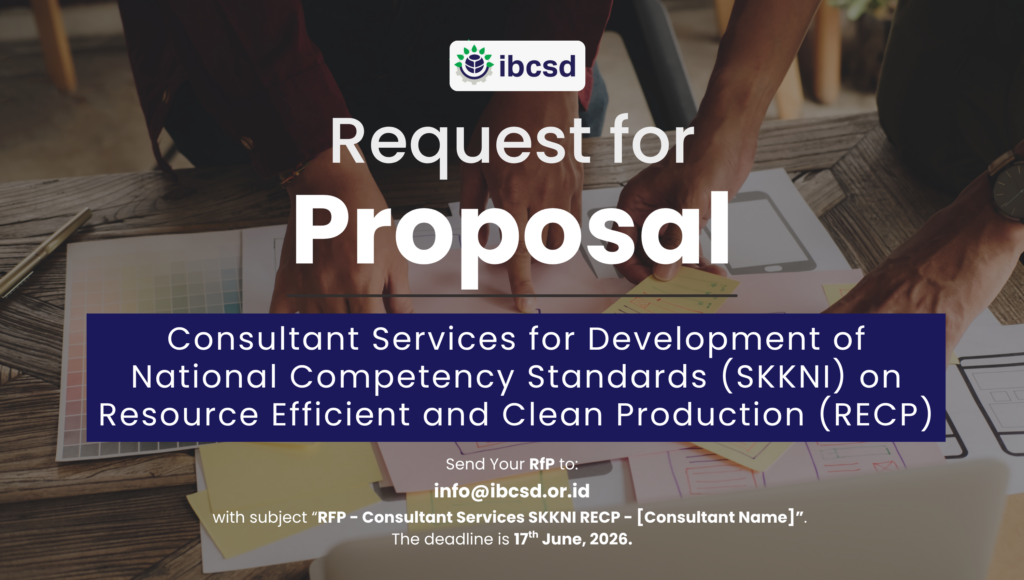
Consultant Services for the Development of National Competency Standards (SKKNI) on Resource Efficient and Clean Production (RECP)

  1. Purpose and Objectives

The primary purpose of this consultancy is to support the development of a comprehensive, technically sound, and align with government requirement standard (SKKNI) for Resource Efficient and Clean Production (RECP) In Indonesia, in order to strengthen green skills development, promote green jobs and accelerate the greening of the industrial sector.

The specific objectives are:

  1. Develop a technically and contextually relevant SKKNI RECP document in accordance with the applicable regulatory framework for SKKNI development in Indonesia, including guidelines from Ministry of Labor (Kemnaker)
  2. Facilitate multi-stakeholder engagement and consensus-building on the content of the SKKNI RECP, involving relevant government ministries, industry associations, training providers, and civil society organizations.
  3. Produce an SKKNI RECP document that is ready for formal submission and proposed adoption by the Kemnaker, contributing to the institutionalization of green skills in Indonesia’s industrial workforce.
  4. Support the creation of green jobs by enabling the establishment of certified RECP training programs aligned with industry needs.
  5. Strengthen the linkage between competency standards, workforce development, and industrial decarbonization by ensuring the SKKNI RECP reflects both national policy priorities and practical implementation needs in industry.


  1. Scope of Works

The Consultant will provide technical expertise and project management throughout the full cycle of SKKNI development, from inception to final submission. The scope of work encompasses the following seven  key activities:

  1. Development of Draft SKKNI by Expert Team

     The Consultant will lead a qualified team of RECP and SKKNI experts to develop the first draft of the SKKNI RECP through benchmarking national and international competency standards, integrating existing RECP training materials, and structuring the document in accordance with Kemnaker requirements for internal review and stakeholder consultation.

  1. Conduct occupational mapping and functional analysis

    The consultant will conduct mapping to identify relevant job roles and competency units within the RECP ecosystem.

  1. Engagement with Relevant Ministries

    The Consultant will conduct structured consultations with relevant government ministries, including Kemnaker and KLH, to ensure the SKKNI RECP aligns with applicable regulations, environmental standards, and green industry priorities, while documenting all engagement outcomes for reporting to IBCSD

  1. Focus Group Discussion (FGD) 1 – Draft Review and Data Completion

     The Consultant will organize and facilitate the first FGD with relevant stakeholders from government, industry, training institutions, civil society, and academia to review the zero draft of the SKKNI RECP, gather technical inputs, and collect additional data to strengthen and finalize the document. Following FGD 1, the Consultant will update and refine the draft SKKNI to produce a Second Draft, incorporating all inputs and data collected during the discussion.

  1. Focus Group Discussion (FGD) 2 – Second Draft Review and Data Completion

     The Consultant will organize and facilitate a second FGD to review the updated Second Draft of the SKKNI RECP, address remaining technical issues, strengthen stakeholder consensus, and incorporate final inputs into the Third Draft of the document. 

  1. Finalization of SKKNI Draft

    The Consultant will finalize the draft SKKNI RECP by consolidating inputs from both FGDs and stakeholder engagements, ensuring compliance with Kemnaker requirements, and submitting the completed document to IBCSD for review and approval prior to the Validation Workshop

  1. Validation Workshop

    The Consultant will support IBCSD in organizing and facilitating a formal Validation Workshop, in coordination with relevant ministries, to validate the finalized SKKNI RECP draft, confirm stakeholder consensus on competency units, and document all outcomes in a comprehensive workshop report.

  1. Final Revision and Submission

   Following the Validation Workshop, the Consultant will finalize the SKKNI RECP document by incorporating all validation feedback, preparing the complete submission package in line with Kemnaker requirements, and supporting IBCSD in the formal submission process for adoption consideration

  1. Outcomes

The expected outcomes from this consultancy include:

  1. A technically sound and government-ready SKKNI RECP document developed in alignment with Kemnaker regulations and prepared for formal submission and adoption.
  2. Strengthened coordination and alignment with key ministries, particularly Kemnaker and KLHK, to support institutional buy-in for the SKKNI RECP.
  3. Comprehensive documentation of stakeholder inputs, technical feedback, and findings gathered through the FGDs and stakeholder engagement process to strengthen the SKKNI content.
  4. A validated SKKNI RECP draft endorsed through a multi-stakeholder Validation Workshop involving representatives from government, industry, training institutions, civil society, and academia.
  5. A finalized submission package to support IBCSD’s advocacy efforts toward the formal adoption of the SKKNI RECP, contributing to the advancement of green skills development and green job creation in Indonesia’s industrial sector.
  1. Task, Deliverables, and Expected Schedule

It is expected that the consultant will be able to deliver all outputs within 5 (five) months from the signing of contract. The consultant is expected to submit their own detailed timeline and work plan that still in accordance with proposed detailed scheduled below:

No Tasks Deliverables/Products Expected Schedule
1 Kick-off Meeting & Inception Report Inception Report including work plan, detailed methodology, and team structure Week 1
2 Development of SKKNI Draft by Expert Team First Draft of SKKNI RECP document (zero draft) Week 2 – 5
3 Engagement with Relevant Ministries Minutes of Meetings with Kemnaker and KLHK; Kementerian Perindustrian, BNSP, LSP; Engagement Summary Report Week 3 – 6
4 Focus Group Discussion (FGD) 1 Minutes of FGD 1; Updated SKKNI Draft (Second Draft) Week 7 – 8
5 Focus Group Discussion (FGD) 2 Minutes of FGD 2; Revised SKKNI Draft (Third Draft) Week 9 – 10
6 Finalization of SKKNI Draft Finalized SKKNI Draft ready for validation Week 10 – 13
7 Validation Workshop Validation Workshop Activity Report; Post-validation SKKNI Draft Week 14 – 15
8 Final Revision & Submission Final SKKNI Document (Bahasa Indonesia); Executive Summary; Submission Report to Kemnaker Week 16 – 20


  1. Payment Schedule

lagi, The Consultant’s fee will be disbursed in three (3) payment installments (termin) tied to key milestones as follows:

Termin Payment Schedule Milestone/Trigger % of Total Fee
1 Upon signing of contract and submission of Inception Report Signed Contract, Inception Report approved by IBCSD, and submission of Invoice. 30%
2 Upon completion of FGD 2 and submission of Third Draft SKKNI FGD 2 Minutes of Meeting, Third Draft SKKNI accepted by IBCSD (including receipt of comments and/or revision requests, if any), and submission of Invoice. 40%
3 Upon submission and acceptance of Final SKKNI Document Final SKKNI Document approved by IBCSD, Executive Summary and Validation Workshop Report accepted and Approved  by IBCSD, and submission of Invoice. 30%

All payments are subject to the submission and acceptance of the relevant deliverables by IBCSD. Invoices shall be submitted to IBCSD upon achievement of each milestone.


  1. Proposal Submission

The following documents are to be submitted by the Consultant as part of the proposal submission:

  1. Administrative Requirements

The Consultant is expected to submit their legal documents (e.g., Decree of Establishment / SK Menkumham atas Pengesahan Akta, Taxpayer Identification / NPWP), a corporate profile with a good record of performance and integrity, proven experience in technical standard development and/or workforce competency frameworks, and the Curriculum Vitae of the lead consultant and key team members.

  1. Technical Proposal

The Consultant is expected to submit a technical proposal which outlines their understanding of this Term of Reference, their proposed approach and methodology for SKKNI development, and their team’s relevant experience. The technical proposal should contain:

  • A statement of interest describing the proposed team and how it meets the above requirements, including relevant experience in SKKNI development and/or RECP/green industry competency frameworks;
  • An outline of the proposed work plan and methodology;
  • A proposed detailed timeline consistent with the expected 3-month implementation period.
  1. Commercial Proposal

The Consultant is expected to submit a commercial proposal covering all personnel and non-personnel costs in the most competitive offer possible. The commercial proposal should be submitted in Excel (.xls or .xlsx) format with a breakdown of costs sufficient to assess reasonableness and compliance with funder requirements. A competitive payment schedule associating invoice amounts with the milestones outlined in Section G should also be included.

The above documents shall be submitted at the latest of:

Day/Date         :  Friday, June 12 th, 2026

Time                 :  17.00 WIB

  1. Point of Contact

For any clarifications needed by the Consultant, kindly contact the following: [email protected] 

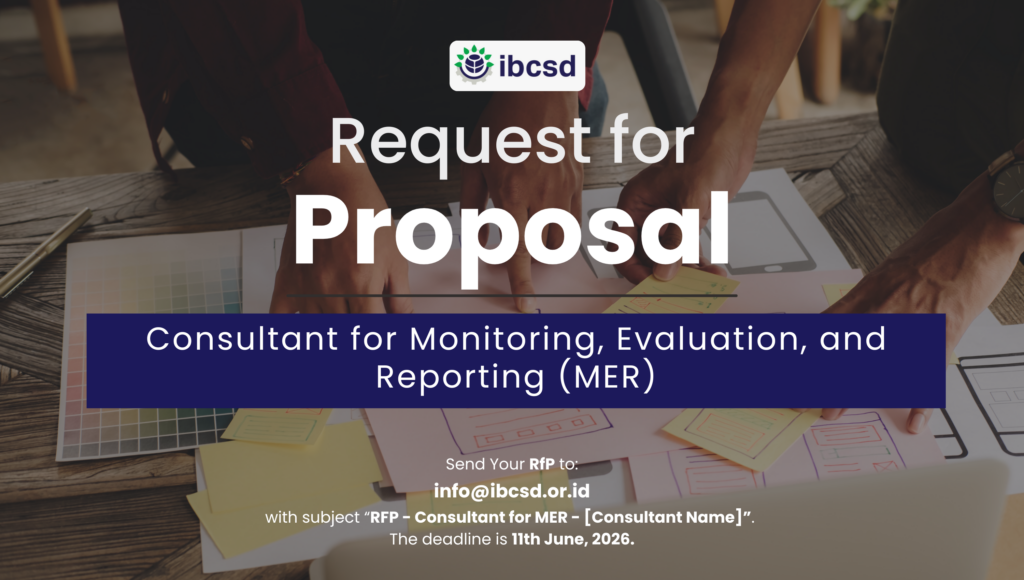
Request for Proposal Position: Monitoring, Evaluation, and Reporting (MER) Consultant.

  1. Scope of Work

The consultant will be responsible for the following tasks:

  1. Program Monitoring
  • Monitor program implementation against the approved workplan and timeline.
  • Track progress toward KPIs, outputs, outcomes, and program targets.
  • Identify implementation challenges, risks, and gaps.
  • Develop monitoring tools such as trackers, dashboards, or monitoring sheets as needed.
  • Coordinate with program teams and implementing partners for data collection and consolidation.
  1. Program Evaluation
  • Conduct analysis of program achievements based on established indicators.
  • Assess program effectiveness, efficiency, relevance, and sustainability.
  • Provide recommendations for program improvement based on evaluation findings.
  • Support the documentation of lessons learned and best practices.
  1. Reporting
  • Prepare periodic program reports (monthly, quarterly, semi-annual, or annual reports).
  • Ensure data quality, narrative consistency, and compliance with donor or organizational reporting requirements.
  • Compile supporting data, activity documentation, and evidence of program achievements.
  • Support the revision and finalization of program reports.
  • Assist in preparing presentations or reporting materials for donors and stakeholders when required.
  1. Knowledge Management and Product Knowledge Development

Collect, organize, and maintain program reports, activity documentation, data, and supporting evidence from different program teams.

Consolidate program updates, achievements, lessons learned, challenges, and key insights into a structured knowledge repository.

Analyze program reports and implementation evidence to identify emerging patterns, strategic insights, and institutional learning.

Support the development of knowledge products based on program results, such as briefs, case studies, learning notes, program summaries, impact stories, and presentation materials.

Translate program evidence and lessons learned into practical knowledge that can support IBCSD’s program development, strategic communication, donor engagement, stakeholder outreach, and institutional positioning.

Ensure that relevant knowledge generated from IBCSD’s programs is properly documented, accessible, and reusable for future program design, reporting, and organizational learning.

  1. Other related work when required
  • Technical assistance for accelerated program implementation based on the monitoring and evaluation feedback


  1. Deliverables

The consultant is expected to produce:

  • Monitoring tracker/program dashboard.
  • Periodic monitoring reports.
  • Program evaluation reports.
  • Consolidated program indicator achievement data.
  • Compilation of program reports, activity documentation, supporting evidence, and lessons learned from relevant program teams.
  • Draft and final donor/program reports.
  • Program learning notes or summary briefs or so based on consolidated reports and implementation findings.
  • Knowledge products derived from program evidence, such as case studies, impact stories, program summaries, presentation materials, or strategic briefs
  • Technical assistance when required to accelerate programme implementation based on the monitoring and evaluation reportsRecommendations for program implementation improvement, knowledge management, and future program development. .
  1. Consultant Qualifications

Education

  • Minimum Bachelor’s degree in:
    • Management,
    • Statistics,
    • Social Sciences,
    • Public Policy,
    • Development Studies,
    • Knowledge management
    • Communications
    • or other relevant fields.

Experience

  • Minimum 3–5 years of experience in Monitoring, Evaluation, Accountability, and Learning (MEAL/MER).
  • Experience working with NGO programs, donor-funded projects, CSR initiatives, or development programs.
  • Experience in donor reporting and program data analysis.
  • Experience in collecting, consolidating, and reviewing reports from multiple programs or project teams.
  • Experience in developing learning documents or knowledge products, such as program briefs, case studies, impact stories, learning notes, or summary reports, is an advantage.
  • Experience coordinating with multiple stakeholders, including internal teams, implementing partners, donors, and external stakeholders, is an advantage.

Technical Competencies

  • Strong understanding of monitoring and evaluation frameworks.
  • Ability to develop indicators and logical frameworks.
  • Strong quantitative and qualitative data analysis skills.
  • Ability to synthesize program findings, lessons learned, challenges, and achievements into clear analytical reports.
  • Strong ability to translate program evidence into institutional learning and knowledge products.
  • Proficiency in Microsoft Excel, Google Sheets, and PowerPoint.
  • Familiarity with data management and visualization tools such as SPSS, KoboToolbox, Power BI, or Tableau is an advantage.
  • Strong report writing skills in both Bahasa Indonesia and English.
  • Ability to prepare concise and strategic presentation materials based on program findings and evidence.

Personal Competencies

  • Strong communication and coordination skills.
  • Detail-oriented with strong analytical thinking.
  • Ability to work independently and collaboratively within a team.
  • Good time management skills and ability to work under tight deadlines.
  • Strong sense of ownership in maintaining data quality, documentation, and institutional knowledge.
  • Ability to work across multiple program themes and translate diverse program information into coherent organizational knowledge.
  1. Assignment Duration

The consultant assignment will be for a period of 3 (three) to 6 (six) months, starting from the effective date of the contract, with the possibility of extension based on program needs and the consultant’s performance evaluation.

The consultant is expected to commence the assignment as soon as possible, with a target start date of 15 June 2026, or as mutually agreed by both parties.

The level of effort for this assignment is estimated at approximately 5 (five) to 10 (ten) working days per month, depending on program needs and deliverables.

  1. Working Arrangement
  • The consultant will work on a flexible/freelance basis according to program needs.
  • The consultant will report directly to the Program Manager/Project Lead.
  • Regular coordination meetings will be conducted as required.
  1. Work Location
  • Remote, hybrid, or on-site arrangement depending on program activities and field requirements.
  1. Required Documents

Applicants are requested to submit:

  • Updated CV,
  • Portfolio or sample reports/programs previously handled,
  • Financial proposal,
  • Availability and proposed timeline.
  1. Application Deadline

Application submission deadline:  June 11, 2026

Applications should be submitted to:[email protected]

Request for Proposal (RFP) Development of Analytical Paper on Strengthening Indonesian Sustainable Palm Oil (ISPO) Governance

In response to these developments, the Government of Indonesia has strengthened the Indonesian Sustainable Palm Oil (ISPO) certification framework through a series of regulatory reforms aimed at improving sustainability compliance, governance, traceability, and institutional coordination. Despite these efforts, significant challenges remain regarding implementation effectiveness, institutional capacity, smallholder inclusion, transparency, market credibility, and international acceptance. There is therefore a growing need for a comprehensive and evidence-based policy paper that critically assesses the current state of ISPO and identifies strategic pathways for strengthening its governance, implementation, and international positioning.

  1. Objective

The objective of this assignment is to develop a policy paper that analyses the current state, challenges, and future direction of ISPO across six interrelated dimensions:

  • Global and domestic policy context;
  • Standards and certification quality;
  • Stakeholder acceptability and credibility;
  • Institutional and governance arrangements;
  • Communication strategy and international positioning; and
  • Reform urgency and implementation challenges.

The study is expected to generate practical, evidence-based, and actionable policy recommendations to strengthen ISPO implementation, institutional effectiveness, market credibility, and smallholder inclusion within Indonesia’s sustainable palm oil governance framework.

  1. Scope of Work

The selected consultant/research team will be expected to:

  • Analyze global regulatory developments and domestic policy evolution related to sustainable palm oil governance, including implications of EUDR, ESG-related trade requirements, and sustainability expectations in major export markets.
  • Review the 2025 ISPO regulatory framework and conduct comparative analysis with major sustainability certification systems, including RSPO, ISCC, MSPO, and other relevant international standards.
  • Assess stakeholder perceptions, market acceptability, and the credibility of ISPO among international and domestic stakeholders, including buyers, government institutions, civil society organizations, plantation companies, and smallholders.
  • Examine ISPO’s institutional architecture, governance arrangements, implementation mechanisms, and inter-agency coordination under recent regulatory reforms.
  • Analyze Indonesia’s communication strategy, economic diplomacy, and international positioning on sustainable palm oil governance.
  • Identify key reform priorities, implementation gaps, institutional constraints, and market risks affecting ISPO credibility, traceability, and implementation effectiveness.
  • Develop evidence-based and actionable policy recommendations to strengthen ISPO governance, institutional coordination, smallholder inclusion, and international positioning.
  1. Expected Deliverables

The selected consultant/team is expected to deliver the following outputs:

  • Full Policy Paper: Approximately 4,000–6,000 words covering all thematic areas, analytical findings, and policy recommendations.
  • Executive Summary: A concise one-page summary highlighting key findings, strategic implications, and recommendations for policymakers and senior stakeholders.
  • Presentation Slide Deck: Presentation materials (approximately 15 slides) summarizing the study’s objectives, methodology, key findings, and policy recommendations, designed to support stakeholder consultations and policy discussions.
  • Stakeholder Consultation: 2-page summary of key findings from stakeholder consultations, including major concerns, policy priorities, areas of consensus and disagreement, and implications for the study’s recommendations.
  • Policy Brief (Optional): A two-page policy brief outlining priority recommendations and strategic considerations for broader stakeholder engagement. 
  1. Qualifications

The assignment requires a consultant, research institution, or expert team with:

  • Advanced academic background in public policy, international relations, economics, environmental governance, sustainability studies, or related fields;
  • Minimum 5–7 years of experience in policy research, governance analysis, sustainability, trade, or environmental governance;
  • Strong understanding of sustainable palm oil governance and certification systems, including ISPO, RSPO, ISCC, NDPE commitments, EUDR, and ESG-related frameworks;
  • Proven experience in regulatory, institutional, or comparative governance analysis and policy recommendation development;
  • Familiarity with Indonesia’s political economy and sustainability governance landscape; and
  • Experience engaging with government, private sector, civil society, development partners, and smallholder stakeholders.

Please submit your CV and a one-page summary of relevant experience for the position to Nadila Simbolon at [email protected] no later than Friday, 12 June.

Request for Proposal: End of Project Report Writer

The objective of the SAFE Regional Dialogue is to:

  1. Enable shared understanding of EUDR compliance requirements and deep dives into the challenges in applying the legality and traceability aspects for operators, traders, and smallholders focusing on palm oil, rubber, and cacao in Indonesia and Malaysia.
  2. Demonstrate inclusive supply chains across that of three commodities sectors are transitioning toward EUDR through regional technical dialogues. 

The project will conclude on March 14, 2025. Therefore, a final project report is required to comprehensively summarize all project activities carried out during the contract period.

SCOPE OF WORK

 The IBCSD – TFA secretariat opens recruitment for Technical Consultant, with the following scope of work (job description):

Proposal for End of Project Report Writing

  1. Develop report that summarize all project activities implemented March 2024 to March 2026 as outlined in the project documents and implementation plan.
  2. Ensure that the report’s valid references stem from the released resources, persons, and publications.
  3. Integrate inputs from consortium members to ensure valid and correctness of the sources and information before the public release
  4. Ensuring final reviews and verify any information based on the discussions and or other resources of information
  5. Final report submission

QUALIFICATIONS and SKILLS

  1. Organization or Individual that demonstrate experiences in report-writing experiences in capturing project summary, documentations and conclusions.
  2. Proven track record of knowledge and expertise’s in engaging with forest, commodities, and jurisdictional approaches related-context.
  3. Demonstrating capacity in evidence-based writing skills with critical and analytical thinking

Timeline

Activities Timing Output
Contract signing 19 February Contract signed
Briefing 20 February  
First draft submission 27 February 1st draft
Second draft submission 6 March 2nd draft
Third and or Final draft submission 10 March Final draft


Please send your TOR and submit your CV and one pager experiences relevant to the required position to Dame Manalu at [email protected]  at the latest by 18 February 2026.

Request for Proposal (RFP) Title: Development of Analytical Paper: Malaysian Palm Oil Board (MPOB): Institutional Authority, Policy Coherence, and Strategic Lessons for Indonesia’s Sustainable Palm Oil Governance and Diplomacy

  1. Objectives

The analytical paper aims to:

  • Map the institutional architecture, legal mandate, governance structure, and operational functions of MPOB.
  • Analyse how MPOB integrates regulation, research, certification oversight (MSPO), market intelligence, and strategic coordination.
  • Examine the functional relationship between MPOB and MPOC, clarifying their respective roles in Malaysia’s palm oil ecosystem.
  • Assess how MPOB enables policy coherence and rapid response to global regulatory and market pressures, including EUDR.
  • Derive strategic lessons and institutional design options for strengthening Indonesia’s palm oil governance and diplomacy architecture, including sustainability and traceability initiatives.
  • Examine financing mechanisms and resource allocation for MPOB initiatives.
  1. Scope of Work

The study will cover five interconnected thematic areas:

  1. Institutional and Governance Architecture of MPOB
  • Legal mandate, governance structure, and decision-making authority
  • Funding mechanisms and accountability
  • Coordination with the Ministry of Plantation and Commodities, MPOC, MSPO Secretariat, and other agencies
  1. Regulatory, Research, and Sustainability Functions
  • MPOB’s role in R&D, productivity, and innovation
  • Oversight of MSPO and sustainability positioning
  • Data generation, traceability, and interface with global frameworks (NDPE, ESG, EUDR)
  1. Market Intelligence and External Policy Response
  • Support for market strategy and risk anticipation
  • Responses to EUDR, forced labour scrutiny, and trade barriers
  • Engagement with importing countries and buyers based on evidence
  1. Comparative Reflection: Malaysia and Indonesia
  • Fragmentation vs. institutional consolidation
  • Strengths and weaknesses of Indonesia’s governance
  • Leverage points in communication, data authority, and policy coordination
  1. Strategic Options and Recommendations for Indonesia
  • Institutional reform pathways (e.g., ISPO Secretariat, data authority)
  • Integrating communication, intelligence, and policy response
  • Lessons from MPOB without direct replication
  • Implications for Indonesia’s palm oil diplomacy and market positioning
  1. Expected Outputs
  1. Full Analytical Paper (4,000–6,000 words)
    • Background and rationale
    • MPOB institutional mapping
    • Strategy and policy analysis
    • Comparative reflection
    • Strategic recommendations
  2. Executive Summary (1–2 pages)
    • Targeted at senior policymakers and high-level dialogues
  3. Slide Deck (15–20 slides)
    • Suitable for TFA and WEF platforms
  4. Optional Policy Note (2 pages)
    • Focused on institutional reform options for Indonesia’s palm oil governance and diplomacy
  1. Qualifications and Skills

The assignment requires a consultant, research institution, or expert team with:

  • Advanced academic background in public policy, international relations, economics, environmental governance, or related fields.
  • Minimum 7 years of relevant experience in policy research, advisory, or strategic analysis related to agricultural commodities, sustainability, or trade.
  • Strong knowledge of palm oil sustainability frameworks (NDPE, MSPO, ISPO, RSPO) and sustainability-related trade regulations, including EUDR.
  • Proven experience in institutional and comparative governance analysis, with ability to translate findings into policy-relevant insights.
  • Solid understanding of Southeast Asian political economy, with practical experience in Malaysia and Indonesia preferred.
  • Excellent analytical writing and presentation skills in English, with capacity to deliver high-quality outputs under tight timelines.
  • Demonstrated experience in one or more of the following areas: palm oil or natural resource governance; trade policy and ESG frameworks; strategic communication, public diplomacy, or narrative analysis.

Please submit your CV and a one-page summary of relevant experience for the position to Nadila Simbolon at [email protected] no later than Friday, 23 January.

Request for Proposal: Video Development for Regional Technical Dialogue on EUDR Project

PURPOSE OF THE VIDEO

The RTD Partners seeks to develop a high-quality video to:

  • Foster regional learning and knowledge sharing by capturing lessons from the implementation of the EUDR Regional Technical Dialogue across ASEAN.
  • Synthesize key insights and perspectives by summarizing challenges, opportunities, and multi-stakeholder views across commodity sectors, including smallholders, private sector, associations, and governments.
  • Highlight solutions and promote dissemination by documenting practical examples, recommendations, and progress on EUDR readiness for regional partners, donors, and policymakers.

The video will serve as a knowledge product to increase awareness, share practical experiences, and strengthen cross-country collaboration in meeting EUDR requirements.

SCOPE OF WORK

The IBCSD–TFA Secretariat seeks a qualified Technical Consultant / Video Development Specialist to carry out the following tasks:

  1. Concept Development
  1. Curate initial ideas, storylines, and key messages for the video.
  2. Present proposed concepts to the consortium for alignment.
  3. Integrate feedback from key stakeholders into the final video concept note.
  1. Data Gathering & Stakeholder Engagement
  1. Conduct bilateral meetings, interviews, and/or participate in FGDs and RTDs with sector stakeholders (smallholders, private companies, commodity associations, government bodies, NGOs).
  2. Gather relevant visual footage (e.g., rubber/palm/cocoa plantations, interviews, dialogue sessions).
  3. Collect insights, case studies, and materials to inform the video narrative.
  1. Content Development
  1. Draft the video script and storyline based on collected data and consultation results.
  2. Produce a first-cut video (including narration, graphics, subtitles, and animations as needed).
  3. Incorporate iterative feedback from consortium partners.
  4. Provide post-production editing and final tuning of the video in consultation with the consortium
  1. Finalisation & Delivery
  1. Produce the final version of the knowledge video, optimized for:
  • Event presentations
  • Online platforms (YouTube, websites, social media)
  1. Provide all raw footage, working files, and final rendered versions.
  2. Deliver a short documentation note summarizing the process, messages, and recommended use cases.

DELIVERABLES

The consultant is expected to deliver:

  1. Video Concept and Key Messages Deck
  2. Script and Storyboard
  3. Raw Footage & Interview Recordings
  4. Draft (First-cut) Video
  5. Provide voice-over, infographics, key facts, figures, and/or statistics for the video
  6. Provide clean versions (with and without subtitles) of the edited video and deliver to hard drive; and digital drive
  7. Final Knowledge Video (duration approx. 4–7 minutes)
  8. Provide the short version of the video (2-minute duration) for social media
  9. Documentation Note summarizing insights captured through production
  1. Perform other duties as required.

TIMELINE

The consultant should be able to deliver the outputs within [4–8 weeks], depending on field logistics and stakeholder availability. A detailed timeline will be agreed upon during contracting.

 QUALIFICATIONS and SKILLS

Applicants must demonstrate the following:

Technical Competencies

  • Proven experience in video production, storytelling, and content development for development or sustainability projects
  • Strong interviewing and field documentation skills
  • Ability to simplify complex technical topics into compelling visual content
  • Familiarity with agricultural commodity supply chains (palm oil, cocoa, or rubber preferred)

Relevant Experience

  • Experience working with multi-stakeholder platforms, NGOs, private sector actors, or government agencies
  • Previous work with international development organizations is an advantage
  • Ability to conduct fieldwork, including visiting plantations or rural sites

Other Skills

  • Excellent communication and coordination skills
  • Ability to deliver high-quality outputs under tight deadlines
  • Mid-level fluency in Bahasa Indonesia and English

Please send your TOR and submit your CV and one pager experiences relevant to the required position to Dame Manalu at [email protected] at the latest by 24 December 2025