| Workshop | Purpose | Focus | Timing |
| 1 | Knowledge, showcasing and contextualisation | Build foundational understanding of the RHINO approach and IBAT and how the two can support implementation of IBSAP, TNFD and other existing biodiversity frameworks. | October/November 2026 – TBD |
| 2 | Technical application and practical training | Practical skills and technical understanding which enables organisations to start exploring RHINO application using IBAT. | 2027 |
| 3 | Action, sharing case studies and future implementation | Consolidate knowledge and the network, share case studies, identify landscapes for co-ordinated multi-stakeholder action, integrate new developments in the approach and operationalise it in an Indonesian context | 2028 |
The workshops are expected to bring together approximately 30 participants from the private sector, government, civil society and scientific communities. The majority of participants will be business representatives.
The first workshop, provisionally planned for October/November 2026, will:
- Build foundational knowledge of the IUCN RHINO approach, IBAT and the STAR metric;
- Explore the relevance and potential application of RHINO in the Indonesian context;
- Demonstrate how RHINO can be adapted to Indonesia’s institutional, regulatory, policy, sectoral and biodiversity context;
- Identify opportunities, challenges, data needs and enabling conditions for applying RHINO in Indonesia;
- Explore how RHINO can complement and support implementation of IBSAP, TNFD and other relevant biodiversity frameworks; and
- Identify priorities for future capacity building, technical training and potential pilot activities.
The second workshop for 2027, subject to development:
- Provides practical skills and technical understanding which enables organisations to start exploring how to apply RHINO using IBAT.
- Dives deeper into the measurement and assessment of species threats and conservation opportunities, using real or illustrative case studies and datasets relevant to Indonesia.
- Showcases alignment with TNFD and other frameworks
- Focuses on hands-on exercises based on sectoral activities and landscapes relevant to Indonesia
The third workshop for 2028, subject to development will:
- Consolidate knowledge gained over the past three years through a national RHINO knowledge-sharing forum in Indonesia to present outcomes, case studies, and lessons learned from Years 1 and 2
- Consolidate the network of biodiversity professionals built through the programme
- Seek to identify landscapes for co-ordinated multi-stakeholder action
- Provide practical guidance on operationalising IUCN RHINO by Indonesian organisations, adapted to the country context, with clarity on how RHINO aligns with and complements national policy and regulatory efforts.
Project team roles
IUCN is leading on technical development of the workshops. IBCSD is managing event logistics and will host and co-facilitate the workshops with the consultant.
To support this process, IUCN is seeking a consultant:
- With strong knowledge of Indonesia’s biodiversity policy and regulatory environment and the corporate sustainability landscape to develop a concise and practical analysis of Indonesia’s policy, regulatory, institutional and corporate landscape relevant to the application of the IUCN RHINO approach. The analysis will identify opportunities for alignment, integration and adaptation of the RHINO approach in Indonesia and will be used as a foundation for the first workshop and subsequent capacity-building activities.
- With proven experience and expertise in workshop design and facilitation, to design the facilitation model and co-facilitate the workshops over the 3-year project cycle.
Workplan agreed with IBCSD
September will be dedicated to formulating the potential pre-workshop ‘launch’ event and workshop
- The project team includes IUCN (IUCN HQ in charge of the project and content development, and IUCN Asia Regional Office managing the relationship with Asian stakeholders) and IBCSD leading on logistics and co-facilitating the workshop.
Overview of activities agreed with IBCSD:
| Activities | Lead |
| 1. Organise potential short ‘launch’ event
Draft agenda and develop content for the launch event
Participant identification and engagement
Secure event logistics set-up: venue, translation, AV etc.
Hosting & Facilitation
Content delivery
*Consultant expected to attend for on-boarding purposes and to use insights to inform workshop 1.
|
IUCN
IBCSD and IUCN ARO
IBCSD
IBCSD
IUCN
|
| 2. Stakeholder identification & engagement for workshop 1
Propose relevant stakeholders from within and beyond the IBCSD network for the workshop. Engage with relevant national, state and local authorities (e.g. municipalities) to secure involvement of priority bodies
|
IBCSD |
| 3. Workshop 1 – content development
Draft agenda and develop content for the workshop.
Consultant develops synthesis of Indonesia’s regulatory environment and its alignment with the IUCN RHINO approach to be integrated into the workshop.
Consultant designs the facilitation model and plans the workshop design and run-of-show in consultation with project team.
|
IUCN
Consultant
Consultant |
| 4. Workshop 1 – Logistics set up
Secure venue, AV set-up and all event logistics
Finalise workshop content package |
IBCSD
IUCN with consultant and IBCSD |
| 5. Workshop 1 – Stakeholder outreach
Manage stakeholder invitations, outreach, and engagement |
IBCSD |
| 6. Workshop 1 – delivery
Event logistics and facilitation of workshop
Content delivery |
IBCSD & consultant
IUCN & consultant |
| 7. Workshop 1 – Post workshop follow-up
Feedback surveys, lessons learned, communication between workshops and reporting back to KNCF |
IUCN/ IBCSD |
A similar workplan will be used for years 2 and 3.
Consultant’s Mission – Scope of work and associated activities
To ensure success of the workshops IUCN wants to mobilise the expertise of a consultant
- with experience and expertise in Indonesia’s biodiversity policy, regulatory environment and corporate sustainability landscape to contextualise the workshop for Indonesia.
- with experience and expertise in workshop facilitation to design and facilitate the workshops.
The consultant will report to the designated IUCN Project Manager and participate in regular coordination meetings with IUCN and IBCSD related to the workshop. The IUCN Project Manager will ensure proper briefing on progress to the consultants and provide any relevant information.
The consultant assignment will focus on:
- developing material and input into the workshops on how the IUCN RHINO approach can best be positioned, aligned and adapted within Indonesia’s existing biodiversity policy, regulatory and corporate landscape.
- Designing the workshops’ facilitation model and co-facilitating the workshops.
The assignment focus for year 2 and 3 will be determined following year 1. An initial indication of year 2 and 3 activities and deliverables is provided below.
Activities
The consultant will be expected to undertake the following activities:
For all three years
- Workshop facilitation design and facilitation delivery
The consultant will:
- Design the facilitation model and format tailored to the objectives of the workshop and to the audience e.g. breakout group structure & interactive exercises – IUCN will provide feedback and inputs.
- Recommend and build content for the workshop e.g. Mural design
- Facilitate the three multi-stakeholder workshops, in collaboration with IBCSD.
- Draft summary notes for each workshop with notes and observations on the process from the facilitator perspective and recommendations
For Year 1
- Integrate insights from ‘launch’ event into design of workshop 1
If the short ‘launch’ event goes ahead in October, use the participant engagement demonstrated at that event (who attends, what questions they ask, how motivated and interested they are in the content, which parts of the content do they seem most interested in), to inform the design of workshop 1 content, facilitation model and delivery style.
- Review and analyse Indonesia’s biodiversity policy and regulatory landscape
Review and synthesise relevant national and, where appropriate, sub-national policies, strategies, regulations and institutional frameworks that are relevant to biodiversity conservation, species protection, land and natural resource management, corporate sustainability and Nature Positive action.
The review should identify the key entry points through which the RHINO approach could support or complement existing Indonesian biodiversity policies, strategies and implementation mechanisms.
- Review of the Indonesian corporate and sectoral landscape
Assess the relevance and potential application of RHINO across key sectors with significant biodiversity impacts and corporate contexts in Indonesia.
The assessment should identify opportunities for RHINO to complement existing corporate practices and help businesses move from biodiversity assessment and disclosure towards practical, measurable actions that contribute to biodiversity outcomes.
- Alignment and contextualisation of the IUCN RHINO approach
Based on the policy, regulatory and corporate landscape review, assess how the IUCN RHINO approach can best be aligned, integrated and adapted to the Indonesian context.
Year 2
Year 2 and 3 activities will be determined subject to workshop 1 and developments in the IUCN RHINO approach over time. An indicative list of activities is provided below. Alongside this the consultant will lead on facilitation design and delivery for workshop 2 and 3, as done for workshop 1.
- Implementation Planning and Readiness Assessment
Undertake a gap analysis and assess how IUCN RHINO can be implemented in Indonesia:
- Identifying opportunities for landscape-level and multi-stakeholder action;
- Identifying relevant data needs, gaps and opportunities, including the availability and suitability of biodiversity and species data;
- Identifying potential barriers and enabling conditions for uptake and implementation;
- Highlighting areas where the RHINO approach may require further guidance for Indonesian users.
Year 3
- Development of learning materials and practical guidance
Based on the analysis, develop learning materials that introduce the RHINO approach in a manner that is relevant and accessible to Indonesian stakeholders.
Consultant’s mission – Deliverables, timeline and budget
The consultant will be expected to deliver the following outputs:
For all three years
Deliverable 1: Workshop facilitation design and facilitation delivery
- Three concept notes presenting the design of the facilitation model and the facilitation tools to be developed.
- Three sessions to facilitate in coordination with IBCSD.
- Three summary notes of multi-stakeholder sessions with notes and observations on the process from the facilitator perspective and recommendations to be completed by an agreed date set by IUCN.
Year 1
Deliverable 2: Inception approach and workplan
A short inception note setting out:
- Proposed methodology and approach;
- Key sources and stakeholders to be consulted (as necessary);
- Proposed structure of the Indonesia RHINO contextualisation analysis;
- Workplan and timeline.
Deliverable 3: Draft Indonesia RHINO contextualisation and alignment overview
A concise, synthetic overview of Indonesia’s relevant regulatory, corporate and sectoral landscape.
The overview should clearly set out how the IUCN RHINO approach could be aligned, integrated and adapted within the Indonesian context, including its potential contribution to international, national and corporate biodiversity goals.
The output should be presented in a PowerPoint presentation or equivalent format, suitable for use as a background and discussion document for Workshop 1 and as a reference for subsequent workshops.
The consultant will coordinate with IUCN to ensure that the materials are technically consistent with the RHINO approach and suitable for delivery by IUCN and project partners. The consultant will revise and finalise the contextualisation overview based on feedback from IUCN and relevant project partners.
Year 2
Year 2 and 3 deliverables will be determined subject to workshop 1 and developments in the IUCN RHINO approach over time. An indicative list of deliverables is provided below. Alongside this the consultant will lead on facilitation design and delivery for workshop 2 and 3.
Deliverable 4: RHINO in Indonesia Implementation Planning and Readiness Assessment
Year 3
Deliverable 5: RHINO learning materials
Develop a set of learning, guidance and presentation materials for Indonesian (and potentially Japanese) stakeholders to implement the IUCN RHINO approach.
The final materials will serve as a basis for future RHINO pilot activities and stakeholder engagement in Indonesia.
Indicative timeline
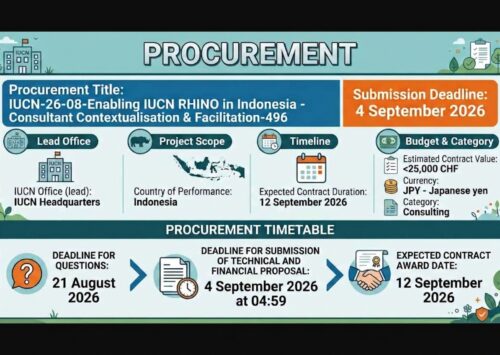
Workshop 1 assignments are predominately expected to be undertaken in September-November 2026, with final materials completed ahead of the first RHINO workshop.
The indicative timeline is:
| Activity | Timing |
| Contracting and inception meeting | August / Early September |
| Inception approach and workplan | Early September |
| Analysis | September |
| Draft contextualisation and alignment overview | Mid September |
| IUCN and partner review | Late September |
| Final contextualisation overview | At least three weeks in advance of workshop 1 |
| Workshop design | October |
| Workshop 1 | October/November 2026. |
The consultant may be expected to participate in selected coordination meetings with IUCN and project partners, and the consultant will be required to attend the short ‘launch’ event in October, if the event takes place.
The timeline for assignments for Year 2 and 3 are to be confirmed following completion of Year 1 assignments.
Budget
The maximum budget is 1560000 Japanese Yen per a year
Requirements
A multidisciplinary team may be proposed where the required expertise cannot be provided by a single consultant. The team lead must meet all requirements listed or provide a good explanation of how as a team all requirements are met.
- Indonesian native with strong knowledge of Indonesia’s biodiversity policy, regulatory and corporate landscape and knowledge of Indonesian stakeholders, diversity and culture;
- Master’s degree in Natural Resources Management, Sustainability, Environmental Policy, Public Policy, Geography, Biodiversity, Biology, Ecology or another relevant field required. Strong grounding in biodiversity, conservation, sustainable development and social science concepts and theory, beyond immediate field of expertise.
- Minimum 8-10 years of experience, and minimum 3 required in engaging and working with multiple stakeholders in Indonesia, including the private sector, government representatives and local communities on biodiversity and/or environmental issues.
- Proven experience in developing and facilitating workshops and webinars with multiple stakeholders
- Proven ability to deliver expected results from workshops/webinars
- Demonstrated experience working on biodiversity conservation, environmental policy, sustainable development, Nature Positive approaches or related fields in Indonesia;
- Knowledge of the Indonesian private sector and corporate sustainability landscape, particularly in relation to biodiversity, ESG, nature-related risks and TNFD;
- Demonstrated ability to quickly understand science & policy documents and synthesise complex policy, regulatory and technical information into clear, concise and visually accessible materials;
- Experience developing professional PowerPoint presentations, learning materials, guidance or other knowledge products;
- Excellent written and spoken English and Bahasa Indonesia is required
- Technical understanding of IUCN key standards, tools and metrics (in particular the IUCN RHINO approach, IUCN Red List of Threatened Species and of Ecosystems and the STAR metric) would be an advantage;