
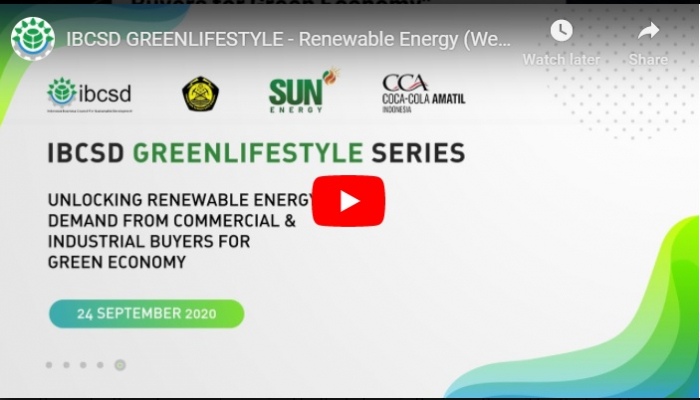
Of all sectors, industry has the largest energy demand followed by the transportation, household, commercial sector and others. Changing conventional energy systems to renewable energy certainly requires investment. If the use of new and renewable energy is accelerated, the investment that must be spent will no longer be a problem, especially since the cost of renewable energy is now lower. “The reduced cost of renewable energy has created new opportunities for its use, including in the commercial and industrial sectors. As the demand for clean energy continues to increase in developing countries, the industrial sector has taken the lead in committing to using clean energy in its operations, ”said Shinta Kamdani, President of the Indonesia Business Council for Sustainable Development (IBCSD). One of IBCSD member companies that have become thought leaders in the use of renewable energy is Coca-Cola Amatil Indonesia, one of the largest bottling companies and distributors of non-alcoholic ready drinks in Indonesia. Just like Amatil, SUN Energy also continues to innovate in providing affordable technology for renewable energy. This discussion regarding the use of renewable energy is part of the Green Lifestyle Program campaign carried out by the IBCSD. IBCSD as a business association that focuses on sustainable issues deliberately provides a platform for the industrial sector to be able to take collaborative action to support the principles of sustainable consumption and production.
Rewatch the webinar here: https://www.youtube.com/watch?
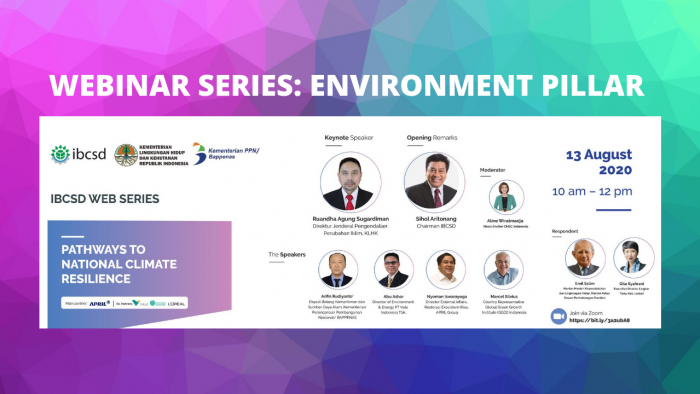
Human and business activities are very influential. We can see this at the beginning of the Covid-19 pandemic when the PSBB policy was implemented, where in Indonesia we had experienced a reduction in carbon emission levels due to reduced community activities outside the home. But unfortunately, this is only temporary. When people and businesses bounce back to their activities, the level of carbon emissions returns to what it was before. Meanwhile, the Indonesian government through the Ministry of Environment and Forestry (KLHK) is working to reduce greenhouse gas emissions.
“From climate change mitigation efforts, the government is committed to reducing our greenhouse gas emissions by 29% compared to Business As Usual or BAU with its own resources, and can reach 41% compared to BAU with international assistance in 2030,” said the Director General of Climate Change Control, Ruandha Agung Sugardiman.
Ruandha also added that the target of reducing greenhouse gas emissions rests on 5 sectors, namely: the energy sector, the waste sector, the industrial sector, the agricultural sector and the forestry sector. Of these five sectors, the forestry and energy sectors are projected to be the largest contributors to the reduction of greenhouse gases in Indonesia. It is hoped that by 2050, Indonesia will be able to realize its long-term vision of “net zero emission and climate resilience”.
In order to support the reduction of greenhouse gas emissions and targeted low-carbon development, the government has integrated climate change and disasters into development planning at both the national and regional levels. In fact, the 2020-2024 National Medium-Term Development Plan (RPJMN) document which was established through Presidential Regulation number 18 of 2020 reflects the government’s great concern on the issue of climate change. This can be seen from one of its chapters which specifically discusses the environment, disaster resilience and climate change.
Even so, the government cannot work alone. Its main business sector, can play a big role in helping achieve this plan. IBCSD itself with a network at the global level, is encouraging its member companies to jointly provide a statement as a joint voice of the private sector to protect, restore and use natural resources in a sustainable manner. IBCSD member companies also have programs for the environment, which are integrated with their respective businesses.
“APRIL Group, in 2013 built Riau Ecosystem Restoration (RER), an ecosystem restoration program that aims to protect, restore and conserve peatland forests in Riau Province, Indonesia. This program is part of APRIL’s commitment to conserving production forests. This program has resulted in no hotspots or fires occurring inside the RER concession in 2018, “said Sihol.
In line with APRIL, as told by Abu Ashar, Director of Environment & Energy, PT Vale Indonesia, the mining company he works for is also building a road map to creating clean energy before 2030. As part of Vale Global Company’s commitment to carbon neutral by 2050, PT Vale Indonesia is committed to reducing greenhouse gass emissions by 33%.
Together with Abu Ashar, present as a speaker, Ir. Medrilzam, M.Prof.Econ, Ph.D, Director of Environment, Ministry of National Development Planning / BAPPENAS; Nyoman Iswarayoga, Director of External Affairs, APRIL Group and Marcel Silvius, Indonesia Country Representative, from the Global Green Growth Institute (GGGI) Indonesia.
On this occasion, Marcel Silvius emphasized the importance of planning for post-pandemic green growth. “Today, more than ever, it is imperative for Indonesia to consider the benefits of green economic development and sustainable, inclusive and resilient economic growth,” he said. Marcel Silvius also provides an example of investing in renewable energy which will provide at least twice as many jobs, and of higher quality, than investment in fossil fuels. Likewise, investment in pro-nature solutions, such as community-based sustainable agroforestry, which can revitalize degraded rural areas, such as Indonesia’s peatlands, and help achieve Indonesia’s commitments to mitigate and adapt to climate change.
“Through our close collaboration with Bappenas and KLHK and other government partners at the national and provincial levels, GGGI continues to support the Government of Indonesia in realizing a pathway for restoring green growth and low carbon development,” added Marcel Silvius, explaining GGGI’s commitment to support the Government of Indonesia.
Apart from the four speakers, Prof. Dr. Emil Salim, former Minister of Population and Environment and former Chairman of the Presidential Advisory Council also attended this webinar. Acting as a responder, Emil Salim agrees with the urgency for low carbon development in Indonesia. This was also conveyed by another respondent, Gita Syahrani, Executive Director of Lingkar Termu Kabupaten Lestari.
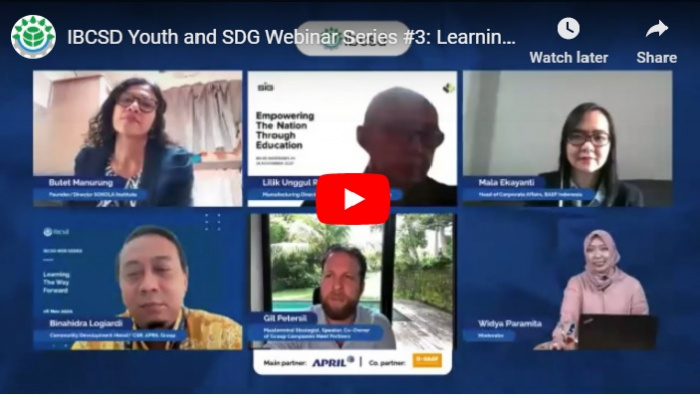
This webinar, supported by APRIL, PT Vale Indonesia, GGGI and L’Oreal Indonesia, is the last in a series of webinars held by IBCSD since last June. In total, there have been four webinars that have been held covering the three pillars of the SDGs, both in the economic, social, and environmental pillars. All webinar reruns can be watched again via the IBCSD YouTube account.
Webserie 3: https://www.youtube.com/watch?v=nhtMB0lKAiI&feature=youtu.be
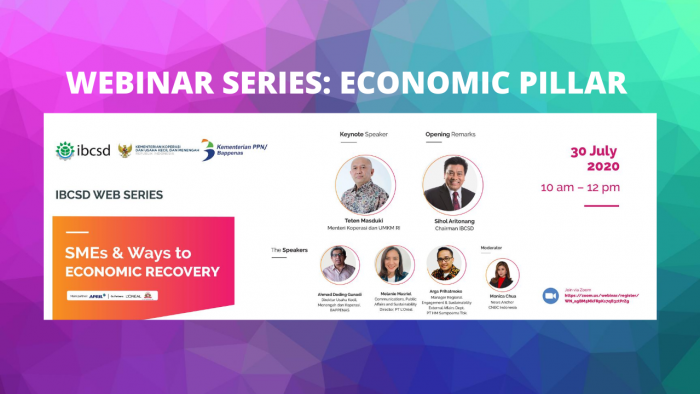
In the IBCSD webseries for economic pillars that focus on MSMEs, and entitled “SMEs and Ways to Economic Recovery”, Minister of Cooperatives and SMEs Teten Masduki in his keynote speech represented by special staff of the Minister for Creative Economy, Fiki Satari, stated that there were 123.46 trillion funds prepared for SMEs in the National Economic Recovery (PEN) program. As of July 30, 2020, 22.57% of these funds or Rp 27.86 trillion had been absorbed.
The important role of SMEs in the national economy reflects the important role of SMEs in achieving the Sustainable Development Goals (SDGs) in Indonesia. MSMEs can be at the forefront of achieving the economic pillars of the SDGs by creating jobs, creating decent working conditions, business innovation, adapting and mitigating negative economic, social and environmental impacts on business operations for inclusive and sustainable economic growth.
Collective action from various sectors is urgently needed to support the revival of MSMEs which have been badly hit by the impact of the Covid-19 pandemic. In this case, the business sector can be a motor for economic growth and job opening. The business sector has the ability to find solutions through technology, innovation and investment. The business sector can also play a role in addressing negative environmental and social impacts through the value chains and supply chains of their business operations. Until now, the business sector has also taken part in developing SMEs for the achievement of SDGs.
“For example, one of our members, the APRIL Group, empowers local communities to improve community welfare through training in sustainable and modern agricultural skills for village farmers in the One Village One Commodity (OVOC) program”, said Sihol Aritonang, Chairman of IBCSD. It is known, APRIL Group works with village communities to select suitable products to specialize in their area, then provides training on modern agricultural methods.
Other example, PT HM Sampoerna Tbk has built a 27 hectare entrepreneurship training center called the ‘Sampoerna Entrepreneurship Training Center’ (SETC) located in Pandaan, East Java. SETC is open to the general public as well as SME’s actors and provides support in the form of free training, access to markets and the use of technology. Since its establishment in 2007, SETC has trained more than 65,000 people and has been visited by more than 110,000 people. Other than thet, PT L’Oreal Indonesia also helps the fostered salons to get back into business in the midst of this new normal.
Present as a speaker at this webinar, Ir. Ahmad Dading Gunadi, MA, Director of Small, Medium Enterprises and Cooperatives, BAPPENAS; Melanie Masriel, Communications, Public Affairs and Sustainability Director, PT L’Oréal; and Arga Prihatmoko, Manager of Regional Engagement & Sustainability, PT HM Sampoerna. In addition, MSME actors were also presented as responders.
Watch the recorded webinar here: Youtube.com/WEBSERIE 2: SMEs and Ways to Economic Recovery
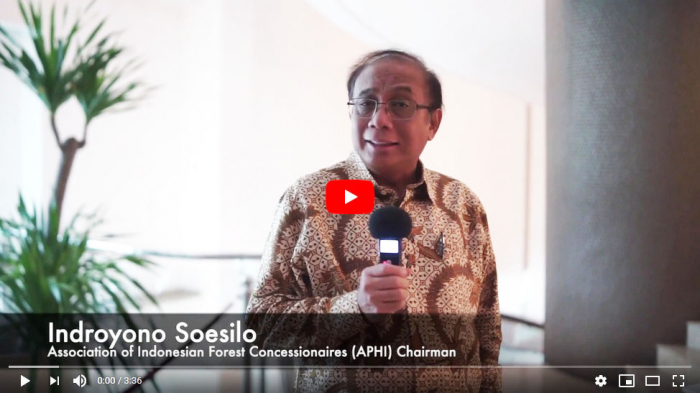
IBCSD and ZSL conducted a discussion on Transparency in Indonesia, and the benefit in joining SPOTT Forum. The event conducted on March 4th, 2020, and attended by representatives from companies, NGOs, government, and other related institutions.