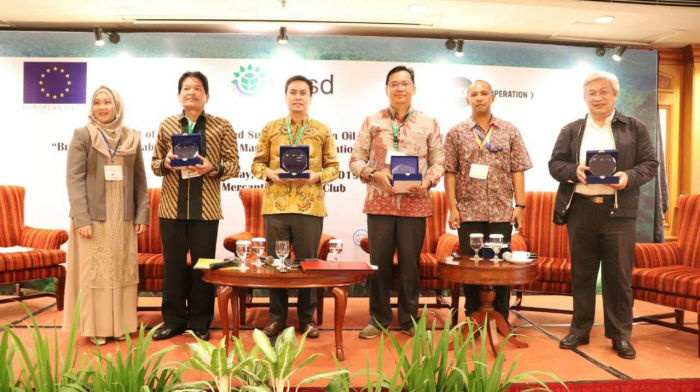
Responsible and Sustainable Palm Oil in Indonesia (RESBOUND) Program Launch

In connection with this initiative, the transformation of the domestic market through building consumer awareness to choose palm products that are produced responsibly is chosen as one of the main strategies. The aim is to build incentives for palm oil producers to operate with regard to aspects of sustainability, and compliance with human rights values and norms.

Global demand for Indonesian palm oil is now beginning to decline and is followed by falling prices, following foreign market awareness about the need for compliance with human rights in the production chain with the principle of sustainability. This has an impact on the lives of farmers and oil palm workers in the village.

As a business association that applies the principle of sustainability, IBCSD sees that awareness of the risks of climate change at the consumer level has encouraged people to prefer sustainable products. This was later revealed by IBCSD executive director, Indah Budiani, “With increasing demand in consumers, the creation of sustainable products will ultimately be able to improve the competitiveness position of Indonesian palm oil in the global market.”

“Meanwhile on the producer side, support for this good initiative has also increased due to the many companies that are aware of business risks if they remain in ‘business as usual’ and do not progress to ‘responsible business'”, continued Indah, “this can be proven by implementing sustainable sourcing and various innovations carried out in an effort to meet the demands of the global market for sustainable products. “
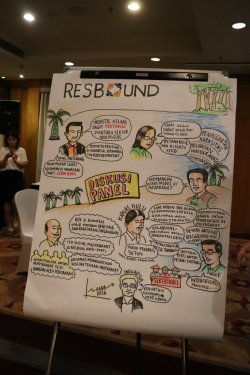
Download Materi Presentasi

Investing Opportunity to achieve SDG 2

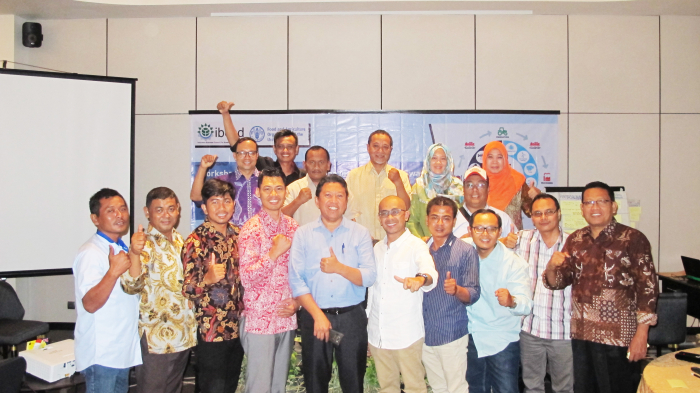
Various key stakeholders from province and district governments, companies, NGOs and academia actively participated in the discussion. “I appreciate the initiative and smart work of IBCSD by conducting this workshop to mobilize business opportunity to support SDG 2. This discussion is very important to solve barriers and seize opportunity to increase business investment in the local flagship commodities, such as shrimp and coffee”, said Choirul Anam, Head of Fisheries Department, Gresik District. Three resource persons are also invited to share their expert knowledge on the workshop topic. They are Satrio Nugroho from PT Central Proteina Prima, a company working on shrimp commodity; Sigit Ismaryanto from Board of Indonesia  Sustainable Coffee Cooperation (ISCC) and Andi Kurniawan from Centre for Coastal and Fishery Study, Brawijaya University.

A number of challenges are discussed in the plenary and group discussion, in particular relating to coffee and shrimp as parts of the local flagship commodities in East Java. On shrimp commodity, the market opportunity at both international and domestic levels are still very high. The challenges, among others are how to provide quality seeds, including different variety of shrimp seeds that can be productively cultivated in different local conditions. Other challenges are how to help small fish folk to get access to financial support, assist capacity building and innovative technology to improve shrimp product quality that can compete at international market and improve coordination and public private partnership in particular to achieve 250% increase of the national target fishery products in the coming years. On coffee commodity, the challenges include how to revitalize the already old coffee plantation; address the current trend that  the increase of coffee consumption is much higher rather than the increase in production;  and provide capacity building and innovation supports, in particular to the fast growing SMEs in coffee value chain industries.  

The result from the workshop will be presented in Jakarta in December, as a final discussion in completing the study.

Choose Products Responsibly: Another side of Palm Oil Industry

In response to this critical issue, the Indonesian government has put serious measures to improve the Indonesian palm oil industry in line with sustainable development principles. Through the Ministry of Agriculture Regulation No. 19/ 2011 the Indonesia Sustainable Palm Oil (ISPO) regulation was issued. This ISPO certification is made mandatory for palm companies that sell their products to international markets through the Minister Regulation No. 11/2015. The Government of Indonesia also has developed policy benefiting smallholder farmers that work in the palm oil sector through the launch of smallholder Replanting Program in 2017. Through this program, President Joko Widodo targeted 2.4 million ha of Replanting Program in 16 provinces. Currently the smallholder farmers share 45.64% of the total palm oil areas along with 49.17% of big private companies and 5.19 of big public companies (BPS, 2018).


The development of sustainable palm oil industry in Indonesia, however, is not only the responsibility of government. All key related stakeholders, including the private sector, civil societies, and consumer communities share equal responsibility to build responsible and sustainable palm oil industry that will bring benefits for decent living of the communities (people), economic sustainability (profit) and environmental sustainability (planet). This is where all of  us, as consumers can contribute by being responsible consumers. Choose products responsibly! 

Follow our Instagram @ibcsd_official 

#chooseproductsresponsibly #RESBOUND

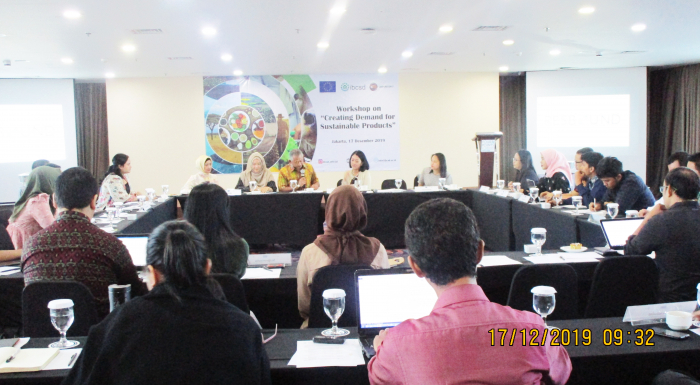
Creating Demand on Sustainable Products

More consumers prefer sustainability in the products they buy shifting demand toward more environmentally friendly goods. In a study on consumer perception conducted by WWF in collaboration with Nielsen (2017), 63% of consumers prefer to buy sustainable products but it is not easy for them to find such products in the local markets. Another research conducted by Nielsen (2019) finds that 75 % millennials change their buying habits by considering environmental sustainability in mind.

As IBCSD Executive Committee stated at the end of the discussion, “Turns out it is still a big question whether we should start with a ‘sustainable demand’ first, or a ‘sustainable product’ for the businesses and market”. She continued, “however, we have now move towards the consumer education.”

When it comes to consumers, it is the millennials territory with their green lifestyle. Producers need to feed the content, educate companies and consumers. To achieve this all, commitment and perseverance is needed.

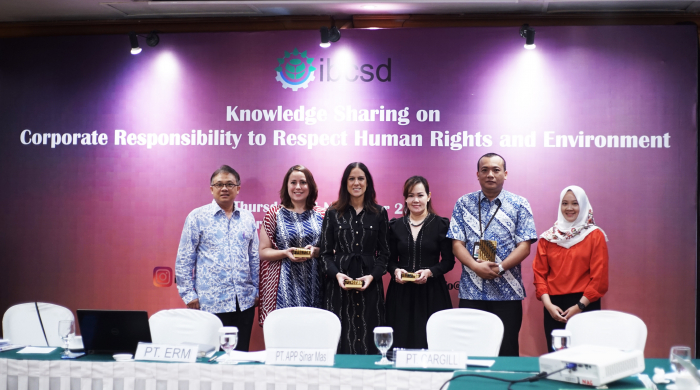
Corporate Respect for Human Rights and Environment

Referring to the WBCSD CEO Guide to Human Rights, Mr. Agus H. Reksoprodjo, IBCSD Executive Committee, in his opening remarks emphasized the long-term benefits of addressing human rights in workplaces and value chains. “The benefits of respecting human rights include: reducing legal and regulatory risks, strengthening reputation, protecting license to operate, acquiring and retaining best talents, winning customers and gaining competitive advantage in the global market”, he said.

Three speakers from the IBCSD member companies shared their current practices on the corporate respect for human rights and the environment. They were Ms. Elim Sritaba (APP Sinar Mas), Ms. Lilian Kallman (AJA Sertifikasi Indonesia) and Mr. Agung Baskoro (Cargill Indonesia). Just to mention examples on their lessons learned, top leadership plays a pivotal role in paving the way for human rights journey in business operations and management. Also, each company has its own challenges to implement corporate respect for human rights and environment in their own contexts.  The challenge is how to collaborate to help smaller companies, SMEs and also smallholders to have equal transformation in respect for human rights and the environment.

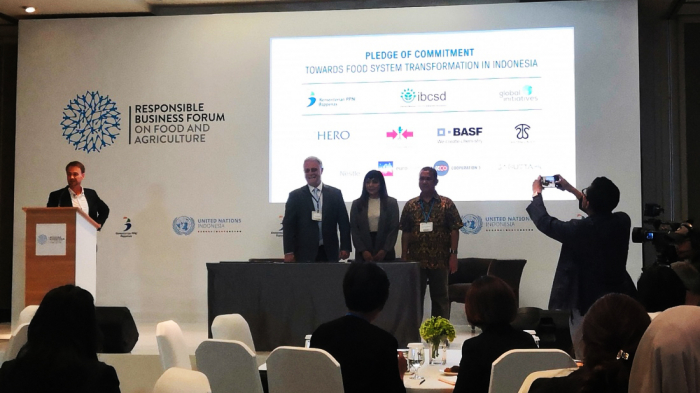
Pledge of Commitment Towards Food System Transformation in Indonesia

The content of the pledge are:

Humanity must transform the food system by 2030 to achieve the Sustainable Development Goals (SDGs) and ensure it can support healthy people, healthy planet and healthy business.

To achieve this common purpose, effective partnership is required among businesses, governments and non-government stakeholders to raise ambitions and take actions to address risks and opportunities in nutrition and health, climate resilience and mitigation, nature and biodiversity,  livelihoods and human rights.

Business can lead to accelerate the food system transformation in Indonesia through both direct and enabling pathways:

1.           Transform agriculture while restoring the environment

2.           Enhance equitable distribution of value

3.           Shift diets to be healthy and sustainable

4.           Minimize food loss and waste

5.           Build end-to-end transparency

6.           Accelerate policy and financial innovations

7.           Launch new business models and value chain collaborations

*For more info on the pledge, please contact [email protected] .

Knowledge Sharing on Food Loss and Waste

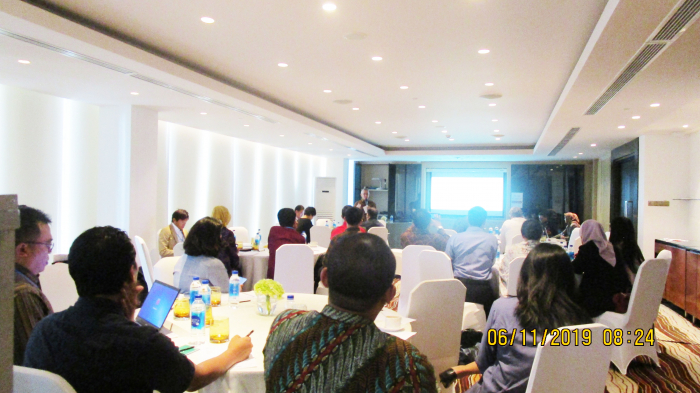
IBCSD explained about Food loss and waste, WRI gave a presentation on research data related to Food Loss and Waste. Foodbank explained the material about the implementation of Foodbank activities in PAUD schools.

This activity has succeeded in increasing public awareness and sharing adequate knowledge about handling the problem of food and waste loss in Indonesia as well as stimulating innovative ideas and opportunities to overcome the problem of food and waste loss from participants who come from the company.

It’s also an opportunity to develop a network for all relevant stakeholders and partners to build partnerships to overcome food loss and waste in Indonesia.


Welcome Asia Pacific Rayon!

Committed to sustainable sourcing and efficient manufacturing, APR’s products address customers’ needs, while touching the lives of the communities around their areas of operations. APR upholds the principles of No Deforestation and source wood fibre only from sustainably managed plantations and forests. It is committed to the transparency of its supply chain. APR aims to achieve a clean production of viscose fibre and will constantly strive to operate in the top quartile of viscose manufacturing in the areas of reduced greenhouse gas (GHG) emissions, improved carbon disulphide (CS2) recovery, and waste water management in line with industry leading practices.