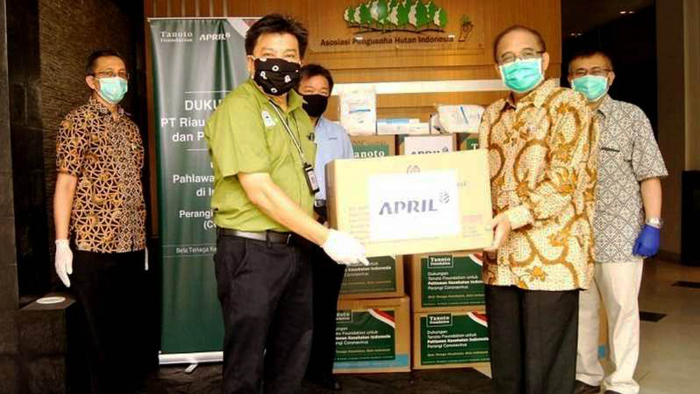
RAPP President Director, also IBCSD Chairman, Sihol Aritonang handed over this assistance directly to APHI Chairperson Indroyono Soesilo. The donation of medical equipment and necessities from these members is a form of the company’s responsibility and care to support the Covid-19 handling program carried out by the Indonesian government specifically through KLHK.
In total, the Royal Golden Eagle through the Tanoto Foundation brought in 100 thousand protective clothing, 1 million masks, 1 million gloves and 3 thousand protective glasses to provide more adequate protection to medical officers in Indonesia. This assistance has begun to be distributed through BNPB (read more here), and also to Covid-19 referral hospitals in Jakarta, Riau and North Sumatra.
Other member of IBCSD, the APP Sinarmas, also put on some donations. The donations are in the form of 40 thousand pcs masks, 1.000 liters of filma cooking oil, and packages of Lianhua Qingwen Herbal medicines from China. Furthermore, the collected aid will be handed over and coordinated with various related parties specifically with the KLHK Covid-19 Task Force.
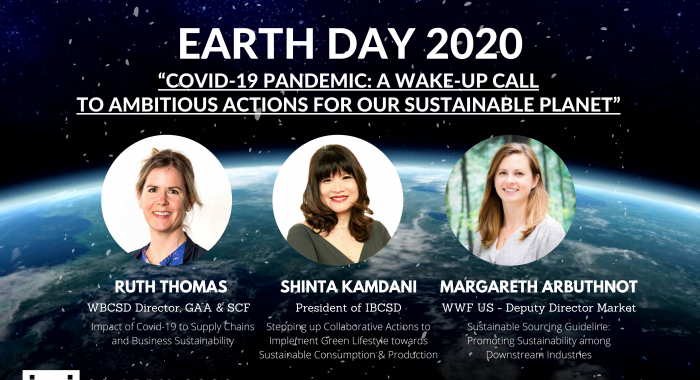
The Sustainable Development Goals (SDGs) were formally agreed by heads of government in 2015 as a global policy agenda and framework for development until 2030. The SDGs consist of 17 goals and 169 targets which are expected to be a reference for global action plans for development 15 next year (2015-2030). IBCSD as a business association committed to supporting sustainable development has also encouraged private sector participation to support SCP through the Green Lifestyle Program since 2017. In 2020 this program has entered the second phase with the aim of strengthening collaboration by involving more business actors and stakeholders related to creating market demand that supports the achievement of SCP in Indonesia.
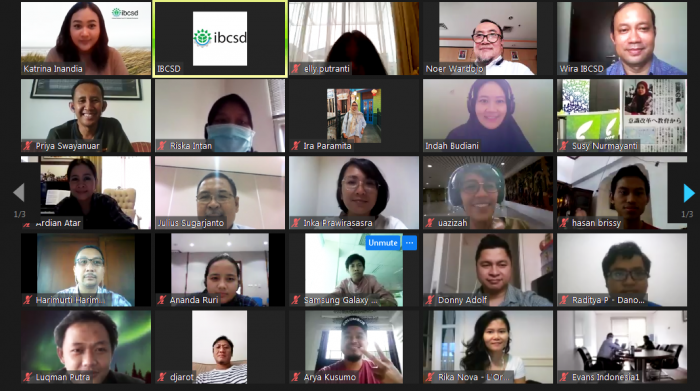
The webinar was attended by Head of Environment and Forestry Standardization Center from the Ministry of Environment and Forestry: Ir. Noer Adi Wardojo, M.Sc. as the main speaker. As stated by Noer Adi in the webinar, IBCSD will take the responsibility to become an official partner of the Ministry of Environment and Forestry regarding the SCP standards for businesses. It is in line with the objective of the webinar, which are: To get input from private sectors on the the framework of Sustainable Consumption and Production (SCP) Indonesia until the year 2030, and to enhance private sector network and collaboration in implementation of the Green Lifestyle project to support SCP (SDG 12) in Indonesia
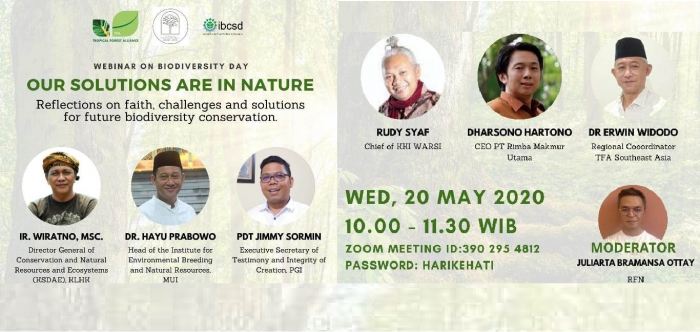
Speakers from various stakeholders shared their insights to increase people awareness and build collaborative actions to steward the biodiversity in Indonesia. Director General for Natural Resources and Ecosystem Conservation, Ministry of Environment and Forestry, Mr. Wiratno, M.Si shared 10 ways to manage forest conservation that among others include seeing community as subject, respect for human rights and local wisdom, cross-sectors collaboration, science based-decision making and multi-layers leadership. From business perspective, Dharsono Harsono, CEO PT RMU, emphasised that to protect forest, businesses need to learn from local community and work seriously for their welfare. “To make the community prosperous is the key for stewarding the forest”, said Dharsono.
The important role of community in conserving the biodiversity was also jointly agreed by the speakers from both indigenous and religious Communities. Director for Indonesia Conservation Community Warsi, Rudi Syaf raised the importance of going back to local wisdom in restoring the biodiversity. “In the past forest was well managed, because the indigenous community saw it as the source of life”, said Rudi. From Islam perspective, Dr. Hayu Prabowo, Head of Environment and Natural Resources Conservation, Indonesia Ulema Council (MUI) shared that MUI has mobilised the communities and organizations to protect the environment through religious approaches, such to integrate textual doctrine and contextual studies on environment, to inspire and empower local leaders and organizations as well as to mobilise investment and assets supporting the environmental protection. Pastor Jimmy Sormin, Executive Secretary for Testimony and Creature Safety, Communion of Churches in Indonesia (PGI) also shared that particularly for the last decade, the churches have been very active to promote awareness, behaviour change and concrete actions for the environment sustainability.
2. Donation of hygiene and personal care products
A total of 673,000 units of personal care products including face wash, shampoo, and moisturizer will be distributed through the National Agency of Drug and Food Control (BPOM), non-profit organizations such as DoctorSHARE and PEKKA, as well as though the Jababeka Industrial Estate where L’Oréal factory is located.
3. Providing grants for COVID-19 research in Indonesia
Research grant will be allocated to Eijkman Institute for Molecular Biology to support research on the whole genome sequencing of COVID-19 in Indonesia. This research is an initial step toward the development of COVID-19 vaccine that is suitable for Indonesian people through data and sample collection from the SARS-CoV-2 virus.
4. Supporting salon business partners
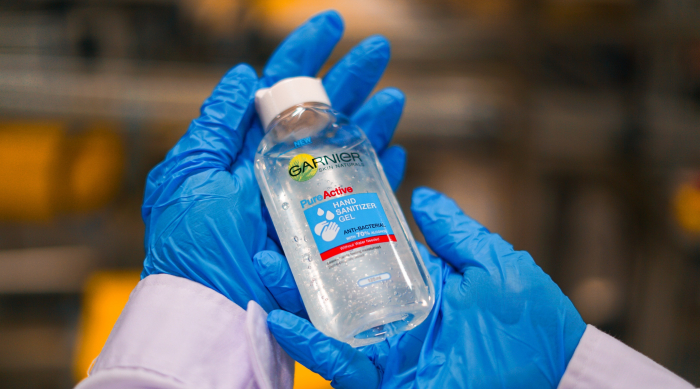
As solidarity to our business partners, the company provides safety and hygiene training, support them to implement social commerce by selling retail product and distributes alcohol-based hand sanitizer. These efforts are aimed to help small and medium salon partners to revive their business post pandemic period.
5. Module and online class #safetogther
In order to ensure that all Group employees are aware of these new measures before they return to their workplace, L’Oréal has developed a dedicated e-learning program, #safetogether, Created in house and in record time, this module will help all employees understand and adopt the new measures that will protect them and their colleagues on a daily basis. In order to enable as many people as possible to benefit from this e-learning, L’Oréal has made a version of this module available for the general public via https://together.na.
The Sustainable Procurement Guide covers five commodity procurement focuses, namely oil palm, wood and paper, seafood, plastics and energy and consists of three parts namely on the concept of sustainability and its benefits; steps that companies need to go through to achieve sustainable procurement; and self-assessment to measure the company’s readiness to implement sustainable procurement.
As a start, PT Hero Supermarket Tbk, PT Wahana Citra Nabati, PT L’Oreal Indonesia, PT Tetra Pak Indonesia, PT Graha Bumi Hijau (Tessa), PT Narendra Lentera Adisakti (Alila Hotel Solo), PT Faber-Castell International Indonesia, PT Foods and Beverages Indonesia (Chatime), and PT Lion Super Indo, have stated their commitment to support the implementation of this guide.
This guide was launched in the midst of the alleged Covid-19 pandemic, one of which, originated from zoonosis, which is the transmission of the virus from wildlife to humans. Zoonoses can occur directly due to wildlife meat sales and consumption activities, and indirectly from commodity production and consumption activities that ignore environmental impacts and thus create environmental conditions that are conducive to mutations and the spread of viruses.
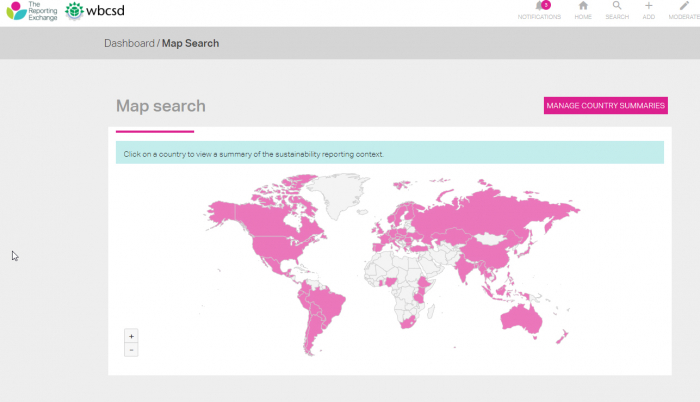
The Reporting Exhange is a free online platform that connects companies and relevant stakeholders to reliable, comparable information on sustainability reporting requirements, resources and indicators. It provides in-depth and up to date coverage across over 70 sectors in 60 different countries including sustainability reporting resources and requirements for Indonesia.
To find out more, visit the Reporting Exchange at www.reportingexchange.com
There is also a WhatsApp-based chatbot service dedicated for adolescent and youth under U-reporter platform with reliable information on Covid-19. Simply send message “Corona” to WA 0811 900 4567.
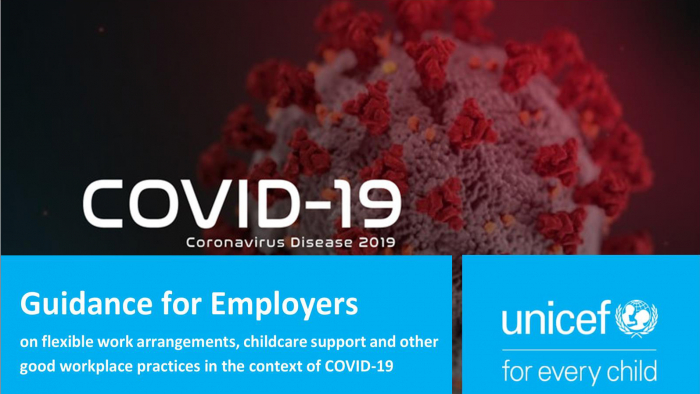
The overwhelming information that are flooding the social media and internet has increase challenges to screen which are valid and false. Therefore, this official kit from UNICEF will be useful for employers to download videos and graphs available at https://www.who.int/
For employees, some steps to prevent the spread of COVID-19 can be found in the WHO Guidance for the Public.
The link for the full guideline in the link below.
Meanwhile other source provided by the Government of Indonesia can be also our reference. You can check it on this link.
Thank you for helping to stop the spread of the virus.
Guideline:
It’s time for businesses to take concrete and decisive action that will not only mitigate the impact of the health crisis, but also ensure that the well-being of people. It needs continuous commitment to the implementation of the 2030 Agenda for Sustainable Development as the Global Investors for Sustainable Development (GISD) Alliance that was just launched in October 2019 has been aimed for. That will lay the foundation for resilient and robust societies.
We hope that you, your families and your colleagues are safe and well.
Source: GISD Alliance